I’ll be honest — when I first heard the phrase “AI that predicts when NHS staff are going to quit,” I was a little sceptical. It sounds a bit like something out of a Black Mirror episode, doesn’t it? But the more I dug into this story, the more impressed I became. Because this isn’t some far-off experiment — it’s a real, award-winning AI tool that’s already being used across a major NHS Trust, and it just scooped one of the most prestigious prizes in UK tech. Let me walk you through what’s going on, why it matters, and what it could mean for the future of healthcare staffing in Britain.
What Exactly Won the Award?
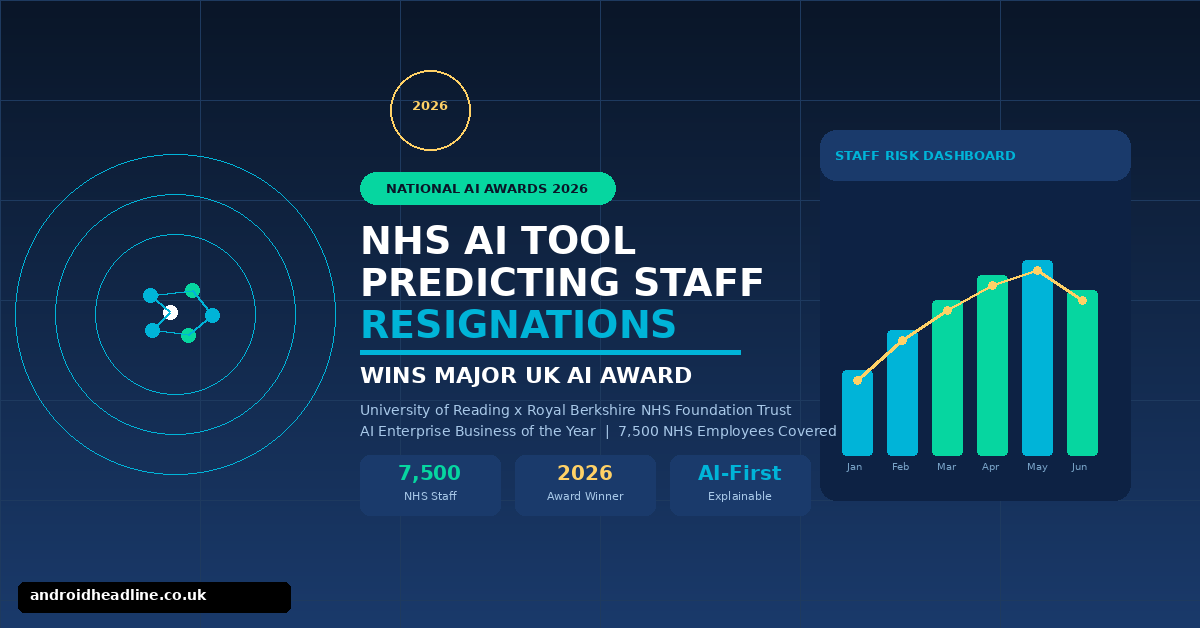
A collaboration between the University of Reading and the Royal Berkshire NHS Foundation Trust (RBFT) has just been crowned The Alconics AI Enterprise Business of the Year at the National AI Awards 2026 — considered one of the highest accolades in UK artificial intelligence.
The project is called “Improving Staff Retention at the RBFT,” and it does exactly what the name suggests. The team developed an AI forecasting tool that analyses workforce data to predict which staff members are most at risk of handing in their notice — before they actually do it.
It covers a workforce of around 7,500 NHS employees, which is no small feat. And the fact that it beat out entries from companies across a whole range of industries makes this win even more impressive.
How the AI Forecasting Tool Actually Works
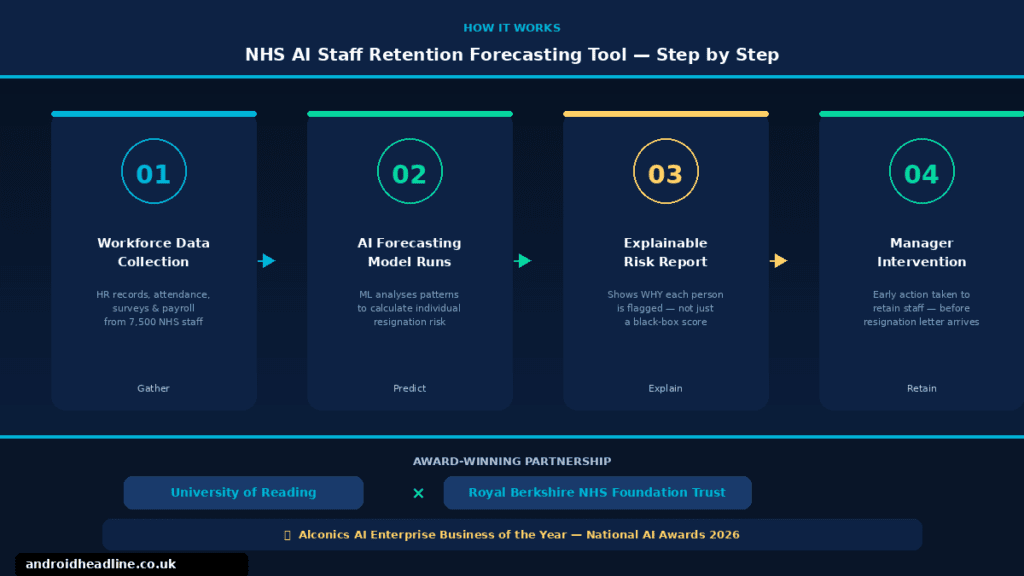
So, here’s where it gets genuinely interesting. This isn’t just a system that spits out a number and tells managers “this person might leave.” That would be a bit useless, honestly. What makes this tool stand out is that it actually explains its reasoning.
It Goes Beyond a Simple Score
The tool highlights the specific factors driving an individual’s risk of resignation. So instead of HR teams being left scratching their heads over a red flag, they can see the why behind the prediction. That’s a massive step forward from what the Trust was using before — a reactive, one-size-fits-all approach that really only kicked in once someone had already mentally checked out.
It Gives Managers an Early Warning
Think of it as a smoke detector for staff retention. By the time someone’s handing in their notice, you’ve often already lost them. This system gives managers a heads-up early enough to actually do something — whether that’s a conversation about workload, flexibility, career development, or something else entirely.
Professor Shixuan Wang from the University of Reading put it well when he said that the award reflects what becomes possible when academic expertise in AI and forecasting is applied directly to real NHS challenges.
Why NHS Staff Retention Is Such a Big Deal
If you’ve followed NHS news at all over the past few years, you’ll know that staff shortages are one of the most serious problems the health service faces. Recruitment is expensive. Training takes years. And when an experienced nurse or doctor walks out the door, the impact ripples through the entire system.
I’ve spoken to people who work in NHS admin, and one thing that comes up again and again is how often management finds out someone’s leaving at the absolute last minute. There’s no runway, no chance to address issues — just a resignation letter and a scramble to find cover.
That’s the gap this tool is designed to fill.
What Makes This Different From Other HR Tech?
There’s a lot of HR software out there that promises to improve retention. Most of it is reactive — it tells you what happened after the fact. This NHS AI tool is different in a few important ways:
- It’s predictive, not reactive. It flags risk before a decision is made, not after.
- It’s transparent. HR teams can see why a prediction is being made, not just what the prediction is. This “explainability” is crucial — nobody wants to act on a black box.
- It’s built for a real NHS context. This wasn’t developed in a Silicon Valley lab and dropped into a hospital. It was co-created with the people who’d actually use it, drawing on real workforce data from the RBFT.
- It’s already working at scale. With 7,500 employees covered, this isn’t a pilot — it’s operational.
According to the National AI Awards CEO Fergus Bruce, this year’s entries had to demonstrate measurable value, responsible innovation, and genuinely practical results. This project clearly ticked every box.
The Bigger Picture: AI in the NHS
This award-winning project doesn’t sit in isolation. The NHS has been steadily increasing its use of AI across a number of areas — from diagnostic tools that can detect cancer on scans to predictive systems for A&E demand during flu season.
What’s exciting about this particular project is that it tackles something often overlooked in the AI-in-healthcare conversation: the workforce itself. Patient outcomes depend on having skilled, experienced staff in post. If AI can help keep those people working in the NHS for longer, the knock-on benefits are enormous.
The University of Reading team behind this project included people from data analytics, strategic HR research, and healthcare workforce operations — a genuinely cross-disciplinary effort. And that breadth shows in the result.
My Take on This
Honestly? I think this is one of the best examples of AI being used responsibly that I’ve seen in a while. It’s not replacing HR managers or making decisions for them. It’s giving them better information, earlier. That’s the ideal use of AI in my view — augmenting human decision-making, not trying to replace it.
There’s also something refreshing about the fact that this wasn’t built by a tech giant. It came from a university-NHS partnership, designed with real clinical and HR context in mind. More of this, please.
What This Means Going Forward
If this model proves as effective as early results suggest, there’s a strong case for rolling it out more broadly across NHS Trusts. The staffing crisis isn’t unique to the Royal Berkshire — it’s a national issue, and tools like this could make a real dent in it.
For other organisations — inside and outside healthcare — there’s also a broader lesson here. Predictive AI doesn’t have to be invasive or dystopian. When it’s designed with transparency, explainability, and a genuine human purpose in mind, it can be a genuinely powerful tool for good.
Wrapping Up
So, to quickly recap: a University of Reading and Royal Berkshire NHS Foundation Trust collaboration has just won the top prize at the National AI Awards 2026 for building an AI tool that predicts NHS staff resignations before they happen. The tool covers 7,500 employees, explains its reasoning, and gives managers the early warning they need to actually intervene.
This is smart, practical, human-centred AI — and it’s exactly what the NHS needs more of.