I’ll be honest with you. The first air conditioner I ever bought was a mistake. I walked into a store, grabbed the biggest unit on the shelf because “bigger means colder,” and dragged it home. Two years later, it broke, my electric bill was a mess, and my bedroom still felt clammy at night.
That’s the thing nobody tells you about buying an air conditioner. It’s not really about finding the coolest-looking box. It’s about three boring, unglamorous details that decide whether you’ll love your AC or regret it by July.
In this guide, I’ll walk you through exactly what to check before you spend your money. No jargon, no sales pitch — just what I wish someone had told me the first time around.
Why Buying the Right Air Conditioner Matters More in 2026
Summers keep getting hotter, and electricity isn’t getting any cheaper. That combination makes your AC choice a bigger deal than it used to be.
A poorly sized or inefficient unit doesn’t just cool badly. It also runs longer, wears out faster, and quietly drains your wallet every single month.
The good news? You don’t need to be an HVAC expert to buy smart. You just need to check three things before you swipe your card. Let’s get into them.
Thing #1: Get the Size (BTU) Right
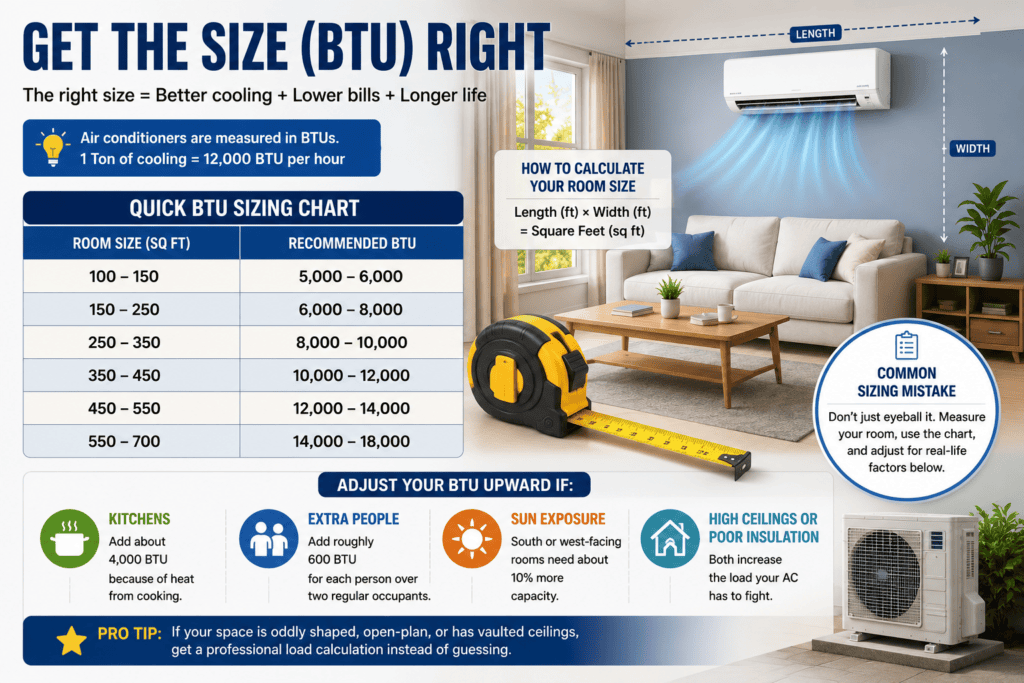
This is the mistake almost everyone makes, including past-me. Air conditioners are measured in BTUs (British Thermal Units), and one “ton” of cooling equals roughly 12,000 BTU per hour.
More BTUs does not automatically mean more comfort. A unit that’s too big cools the room fast, then shuts off before it can pull the humidity out of the air. That’s why an oversized AC can leave a room feeling cold and damp at the same time.
A good rule of thumb is around 20 BTU per square foot as a starting point, then you adjust from there.
Quick BTU Sizing Chart
| Room Size (sq ft) | Recommended BTU |
|---|---|
| 100–150 | 5,000–6,000 |
| 150–250 | 6,000–8,000 |
| 250–350 | 8,000–10,000 |
| 350–450 | 10,000–12,000 |
| 450–550 | 12,000–14,000 |
| 550–700 | 14,000–18,000 |
A few things push that number up:
- Kitchens – add about 4,000 BTU because of heat from cooking.
- Extra people – add roughly 600 BTU per person over two regular occupants.
- Sun exposure – south- or west-facing rooms often need about 10% more capacity.
- High ceilings or poor insulation – both increase the load your AC has to fight.
Common Sizing Mistake
Don’t just eyeball it. Measure your room’s length and width, multiply for square footage, then use the chart. If your space is oddly shaped, open-plan, or has vaulted ceilings, it’s worth getting a contractor to run a proper load calculation instead of guessing.
Thing #2: Check the Efficiency — SEER2, EER, and ENERGY STAR
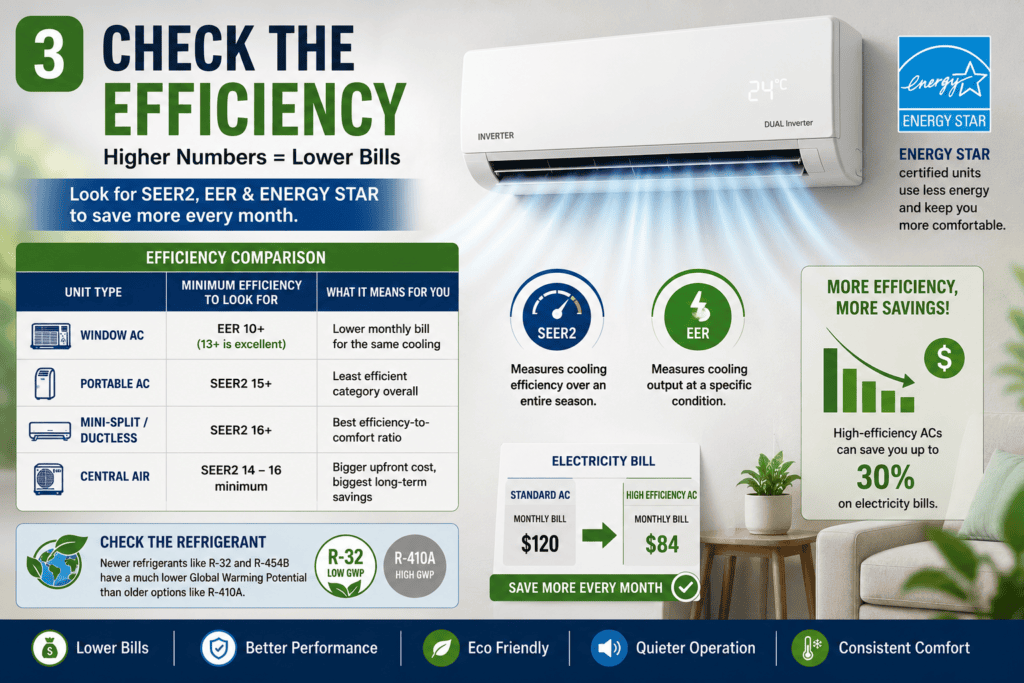
Once you know your size, efficiency is where the real long-term savings hide. Two numbers matter here: EER (Energy Efficiency Ratio) and SEER2 (Seasonal Energy Efficiency Ratio, updated standard).
Simply put, the higher the number, the less electricity the unit uses to produce the same amount of cooling.
Efficiency Comparison Table
| Unit Type | Minimum Efficiency to Look For | What It Means for You |
|---|---|---|
| Window AC | EER 10+ (13+ is excellent) | Lower monthly bill for the same cooling |
| Portable AC | SEER2 15+ | Least efficient category overall |
| Mini-split / Ductless | SEER2 16+ | Best efficiency-to-comfort ratio |
| Central Air | SEER2 14–16 minimum | Bigger upfront cost, biggest long-term savings |
Here’s a tip that’s easy to miss: look for the blue ENERGY STAR label. Certified units are independently tested, and they usually come with tighter seals and better insulation around the housing, which cuts down on annoying air leaks around the unit itself.
It’s also worth checking the refrigerant type. Newer refrigerants like R-32 and R-454B have a much lower Global Warming Potential than older options, so they’re gentler on the environment if the unit ever leaks.
Expert Tip
If you can, choose an inverter-driven compressor over a traditional on/off model. Inverter units adjust their speed instead of cycling on and off, which keeps the temperature steadier and uses noticeably less power over a full season.
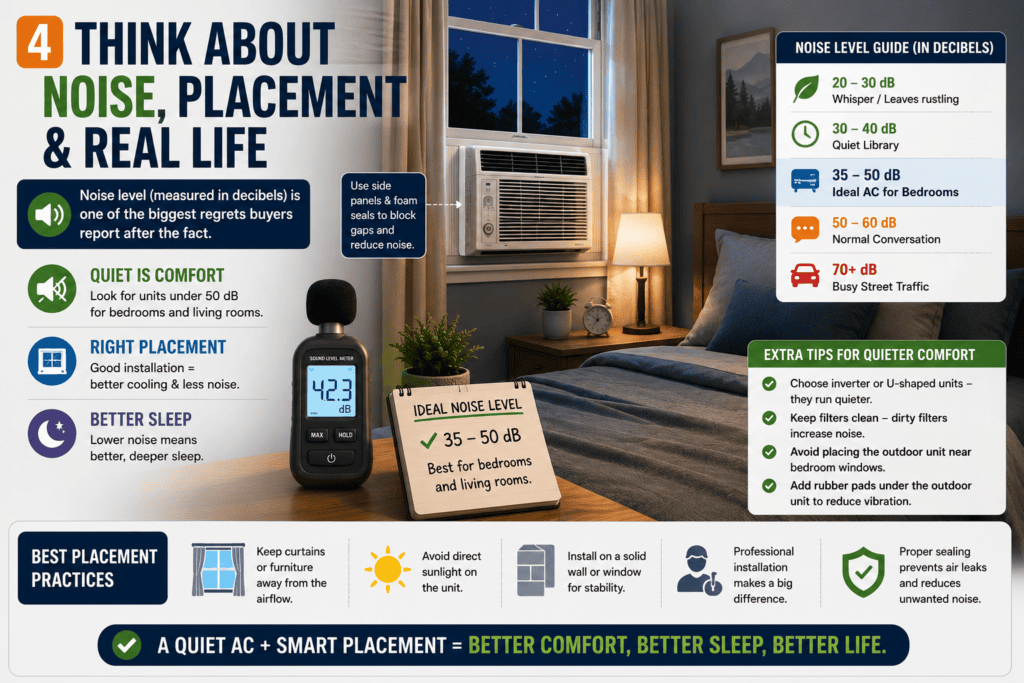
Thing #3: Think About Noise, Placement, and Real Life
This is the one people forget until 2 a.m. when they’re wide awake listening to their AC hum. Noise is measured in decibels (dB), and it matters more than most buying guides admit.
As a rough guide:
- Under 50 dB — quiet enough for light sleepers.
- 50–60 dB — noticeable but tolerable for most people.
- Above 60 dB — can genuinely disrupt sleep and conversation.
Why This Keeps Coming Up
In owner surveys, quiet operation is consistently one of the strongest predictors of whether someone actually likes their air conditioner months later. It matters even more than how fast the unit cools.
U-shaped and inverted U-shaped window units tend to be the quietest on the market right now, because the design tucks the noisy compressor part outside your window frame instead of right next to your bed.
Placement Matters Too
Before you buy, think about:
- Window type – Most units fit double-hung windows. Casement or crank windows usually need a portable or through-the-wall unit instead.
- Airflow direction – If your window isn’t centered in the room, look for a model with adjustable louvers so cool air actually reaches you.
- Drainage – The unit needs to sit level, or condensation can pool and cause damage.
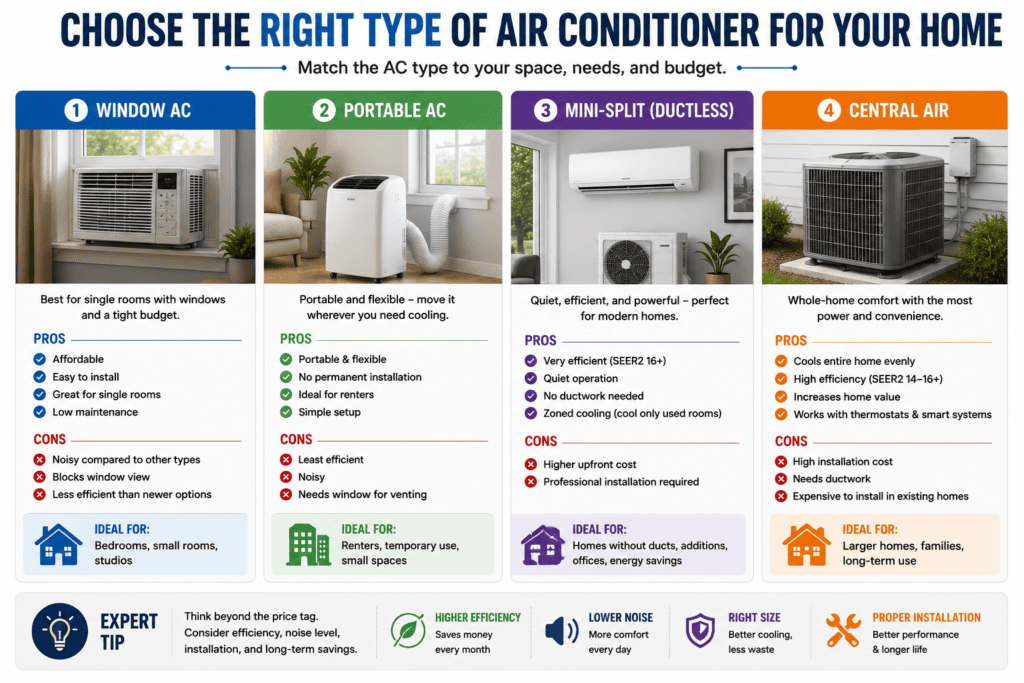
Window vs. Portable vs. Central vs. Mini-Split
Now that you know what to check, here’s how the main types stack up against each other.
| Type | Best For | Efficiency | Noise | Rough Cost |
|---|---|---|---|---|
| Window AC | Single rooms, renters | Good | Low-Medium | $250–$600 |
| Portable AC | No window access to install into, casement windows | Fair | Medium-High | $300–$700 |
| Mini-Split (Ductless) | Whole small home, no ductwork | Excellent | Very Low | $1,500–$5,000 installed |
| Central Air | Whole house with existing ducts | Good-Excellent | Low (outdoor unit) | $4,000–$9,000 installed |
If you rent, a window or portable unit is usually your only realistic option anyway. If you own your home and want long-term comfort in more than one or two rooms, a mini-split is often the sweet spot between cost and efficiency.
Step-by-Step: How to Actually Buy the Right AC
- Measure your room (length × width) to get square footage.
- Check the BTU chart above and adjust for sun, kitchen, or extra occupants.
- Shortlist units with strong EER/SEER2 ratings and the ENERGY STAR label.
- Compare noise ratings in decibels — aim under 50 dB for bedrooms.
- Confirm your window type or wall setup fits the unit’s installation needs.
- Check the warranty, especially on the compressor, since that’s the most expensive part to replace.
- Read recent owner reviews for real-world reliability, not just spec sheets.
Expert Tips and Common Mistakes
Do this:
- Buy slightly under your calculated BTU rather than over it, since a unit that’s too small just runs longer (not damaged), while one that’s too big struggles with humidity.
- Clean or replace filters every month during heavy use. It’s the single easiest way to protect efficiency.
- Compare the annual energy cost estimate on the yellow EnergyGuide label, not just the sticker price.
Avoid this:
- Don’t assume “bigger BTU = better cooling.” It’s the most common and most expensive mistake.
- Don’t skip the noise rating just because the price looks good.
- Don’t install a window unit without weatherstripping — it lets warm air sneak right back in.
My Honest Take (A Quick Story)
Looking back, my oversized AC mistake cost me more in electricity over two summers than the price difference between it and the correctly sized model would’ve been. I genuinely thought I was being smart by “future-proofing” with extra power.
Now I measure the room first, every single time, before I even open a shopping tab. It’s a two-minute habit that’s saved me real money.
Conclusion
At the end of the day, buying an air conditioner doesn’t have to be complicated. Get the size right, check the efficiency rating, and don’t ignore how loud it’s going to be in your actual living room. Those three things matter far more than brand names or flashy features.
If this guide helped you feel more confident about your next purchase, I’d love to hear about it. Drop a comment below with your room size and I’ll help you sanity-check your BTU pick, share this post with a friend who’s AC shopping, and subscribe so you don’t miss the next home comfort guide.
FAQs
1. What size air conditioner do I need for a 300 sq ft room? Aim for roughly 8,000–10,000 BTU for a standard 300 sq ft room, adjusting upward for kitchens, extra people, or heavy sun exposure.
2. Is a bigger BTU air conditioner always better? No. An oversized unit cools quickly but shuts off before removing enough humidity, which can leave the room feeling clammy.
3. What’s the difference between EER and SEER2? EER measures efficiency at a single set of conditions, while SEER2 measures efficiency across a full cooling season, giving a more realistic real-world picture.
4. How loud is too loud for a bedroom air conditioner? Anything consistently above 55–60 decibels can start disrupting sleep. Look for models rated below 50 dB if noise sensitivity is a concern.
5. Do I need a professional to install a window air conditioner? Most window units are DIY-friendly with basic tools, but heavier units (14,000 BTU and up) or upper-floor installs are safer with a second person or professional help.
6. What’s the most efficient type of air conditioner? Ductless mini-split systems generally offer the best efficiency-to-comfort ratio, followed by high-SEER2 central air systems.
7. How often should I clean my air conditioner filter? Every 2–4 weeks during heavy use is a safe rule of thumb to protect both efficiency and air quality.
8. Does ENERGY STAR certification really save money? Yes. Certified units are independently tested for efficiency and typically have better sealing, which reduces the air leaks that waste energy.
MORE INFO VISIT: Androidheadline.co.uk