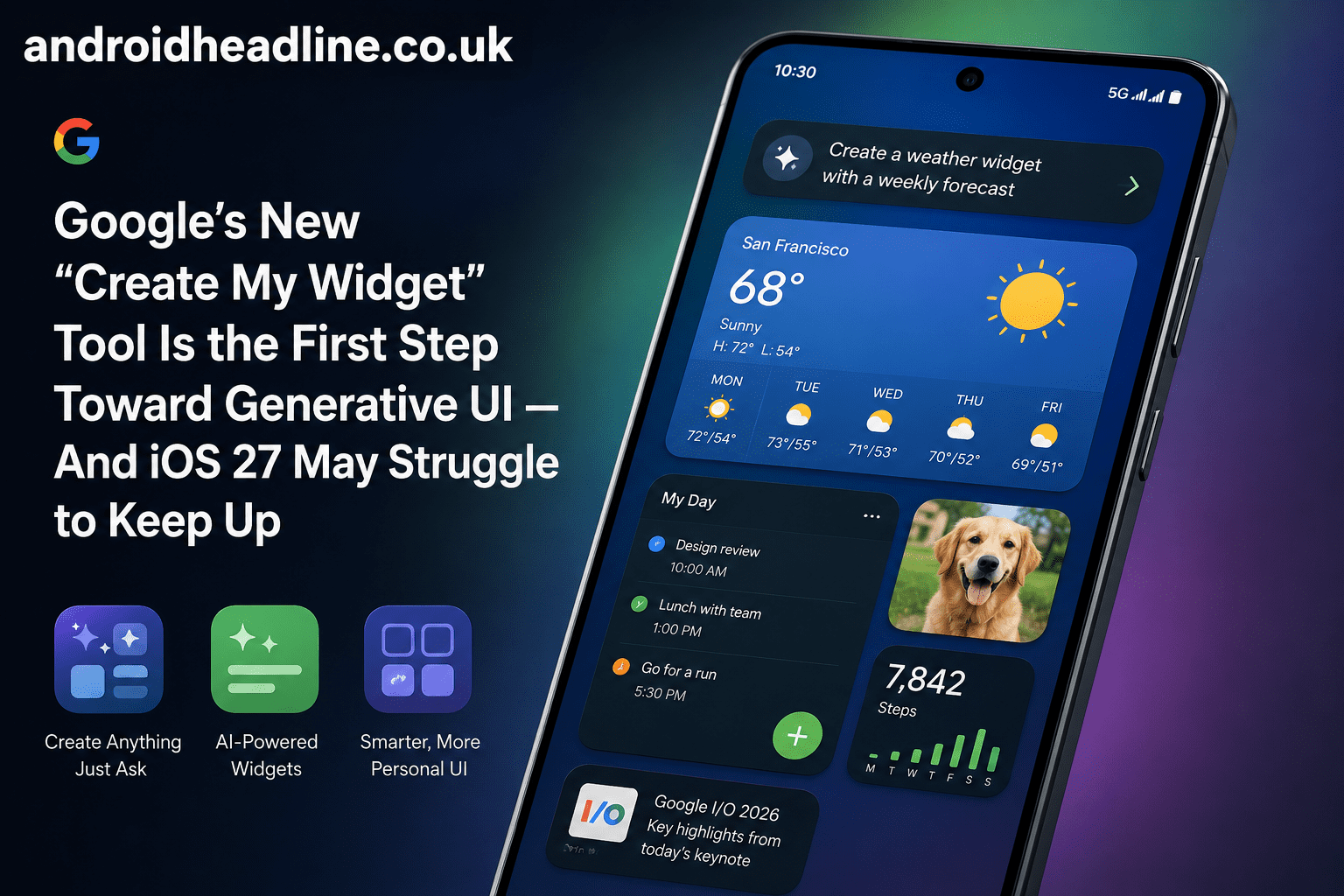
Google is once again pushing Android customization into completely new territory. During its latest AI-focused announcements, the company revealed an experimental feature called “Create My Widget,” a tool that could redefine how users interact with their smartphones. Instead of downloading pre-made widgets or manually designing home screens, Android users may soon be able to generate personalized widgets using AI prompts.
And while Apple continues refining iOS with polished animations and tighter ecosystem integration, Google’s move toward generative UI raises an important question: can iOS 27 realistically compete with Android 17 when it comes to personalization and AI-driven interfaces?
What Is Google’s “Create My Widget” Tool?
Google’s new Create My Widget feature is exactly what it sounds like. Users can describe the type of widget they want using natural language, and AI will automatically generate a functional widget tailored to their request.
For example, users could type prompts like:
- “Create a minimalist weather widget with dark mode”
- “Make a fitness widget showing steps and hydration”
- “Design a gaming-style calendar widget with neon colors”
The AI then builds the widget layout, colors, typography, and data presentation automatically.
This marks a significant shift away from static UI customization and toward something much more dynamic: interfaces generated in real time based on user preferences.
The Beginning of Generative UI
For years, AI has mostly focused on text, images, and voice assistants. But Google’s latest experiment suggests the company wants AI to become deeply integrated into the visual structure of Android itself.
That’s where the term generative UI comes in.
Instead of developers designing every screen manually, AI systems could eventually generate parts of the interface dynamically depending on the user’s habits, mood, location, or activity.
Imagine an Android phone automatically creating:
- A travel-focused home screen before a flight
- A productivity dashboard during work hours
- A gaming interface when launching mobile games
- Health-focused widgets after a workout
This is the kind of adaptive experience Google appears to be building toward with Android 17.
Why Android Has the Advantage
Android has always led the mobile industry in customization. From launchers and icon packs to live widgets and dynamic themes, Google’s operating system gives users far more control over their devices than Apple traditionally allows.
The Create My Widget feature feels like a natural evolution of that philosophy.
Google also has another major advantage: its aggressive AI ecosystem. Between Gemini AI, Android Studio AI tools, and Google’s cloud infrastructure, the company is rapidly embedding generative technology across every layer of Android.
Apple, meanwhile, tends to move more cautiously.
Can iOS 27 Compete?
Apple’s strength has always been simplicity and consistency. iOS delivers a polished user experience that “just works,” but that same design philosophy can sometimes limit creativity and personalization.
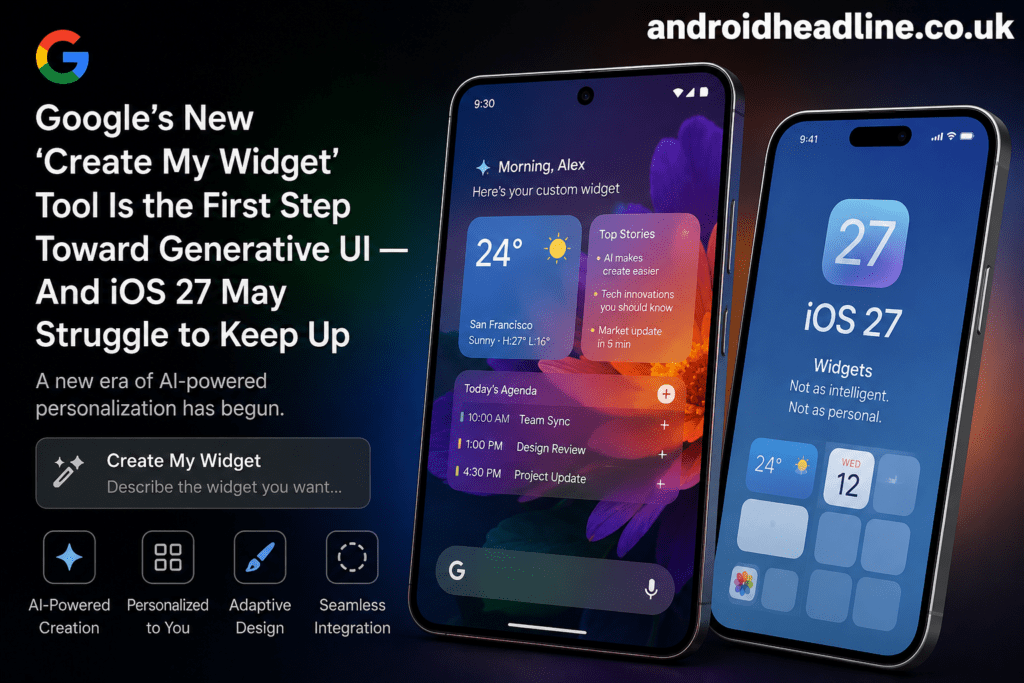
Widgets on iPhone have improved dramatically over the past few years, but they remain relatively controlled compared to Android. Users can rearrange widgets and choose styles, yet true deep customization is still missing.
If Google succeeds with generative UI, Apple may face pressure to rethink how customizable iPhones should become.
The challenge for Apple is balancing:
- User freedom
- Privacy
- Battery efficiency
- Design consistency
Apple is unlikely to allow completely unrestricted AI-generated interfaces overnight. However, competition from Android could eventually push iOS 27 toward smarter, more adaptive widgets powered by Apple Intelligence.
AI Is Becoming the New Smartphone Battleground
The smartphone industry is shifting quickly. Hardware upgrades alone are no longer enough to excite users, which is why companies are racing toward AI-powered experiences.
Google’s Create My Widget tool may seem small at first glance, but it hints at something much bigger: smartphones that design themselves around the user automatically.
That future aligns perfectly with Android’s open ecosystem, where experimentation thrives. Apple can certainly compete, but it may need to loosen some of iOS’s long-standing restrictions to match Android’s AI-driven flexibility.
Final Thoughts
Google’s “Create My Widget” feature could become one of the most important early examples of generative UI on smartphones. Instead of users adapting to their devices, devices may soon adapt to users in real time.
For Android fans, that’s an exciting glimpse into the future.
For iPhone users, it raises a difficult question: if Android 17 becomes deeply personalized through AI-generated interfaces, will iOS 27 feel too limited by comparison?
One thing is clear — the next smartphone war won’t just be about cameras or processors anymore. It will be about which ecosystem can deliver the smartest, most adaptive user experience.