If you’re studying for the NCLEX-RN and you feel like you’re drowning in content, I totally get it. I remember staring at a mountain of nursing notes thinking, “Where do I even start?” That’s exactly why I put together this guide around the RN Fundamentals 2016 Practice Exam. Whether you’re prepping for boards or just trying to nail your fundamentals course, these 70 questions — complete with answers and rationales — are going to be a game-changer. By the end of this post, you’ll have a clear strategy, solid content review, and the confidence to walk into that exam ready.
Why the RN Fundamentals 2016 Practice Exam Still Matters Today
You might be wondering — why focus on a 2016 exam? Here’s the thing: NCLEX-RN fundamentals haven’t changed as dramatically as people think. The core concepts around patient safety, infection control, and basic care principles are still the backbone of modern nursing practice. The 2016 framework aligns closely with the current NCLEX-RN test plan, which makes it an incredibly reliable study tool even now.
According to the National Council of State Boards of Nursing (NCSBN), the NCLEX-RN exam focuses heavily on safe and effective care environments, health promotion, and physiological integrity — all areas covered thoroughly in the 2016 fundamentals exam. So don’t sleep on it just because of the year.
What’s Covered in the 70-Question Practice Exam
The RN Fundamentals 2016 Practice Exam covers the major client needs categories that NCLEX tests. Here’s a quick breakdown of the topic areas you’ll see:
- Safe and Effective Care Environment — infection control, safety protocols, coordinated care
- Health Promotion and Maintenance — developmental stages, preventive care, lifestyle coaching
- Psychosocial Integrity — therapeutic communication, mental health support, coping strategies
- Physiological Integrity — basic care, pharmacology, reduction of risk, physiological adaptation
Each question in this exam is written in the classic NCLEX style — either single-answer multiple choice or alternate format (select all that apply, ordered response, and so on). Getting comfortable with the format is just as important as knowing the content.
10 Sample Questions From the Practice Exam (With Answers)
I’m going to walk you through a handful of questions here so you can get a feel for what to expect. These aren’t the full 70, but they’re a solid preview.
Sample Question Set 1: Safety & Infection Control
Q1. A nurse is preparing to insert a urinary catheter. Which action is the highest priority before beginning the procedure?
- A. Explain the procedure to the patient
- B. Perform hand hygiene
- C. Gather all necessary equipment
- D. Position the patient correctly
Answer: B — Perform hand hygiene Rationale: Hand hygiene is the single most effective measure to prevent healthcare-associated infections. While all options are important, Standard Precautions require hand hygiene before any invasive procedure.
Q2. A client on contact precautions requires transport to radiology. What should the nurse do before transferring the client?
- A. Remove the client’s gown and apply a clean one
- B. Cover the client with a clean sheet and place a mask on them if tolerated
- C. Notify the receiving department only after arrival
- D. No special precautions are required during transport
Answer: B — Cover with clean sheet and apply mask if tolerated Rationale: Covering exposed areas and masking (when appropriate) minimizes pathogen spread during transport outside the isolation room.
Sample Question Set 2: Health Promotion
Q3. A nurse is teaching a 45-year-old client about colorectal cancer screening. Which recommendation is most appropriate?
- A. Begin annual fecal occult blood testing at age 50
- B. Schedule a colonoscopy at age 45 due to average risk
- C. Only screen if there’s a family history
- D. Colonoscopy is not needed until age 60
Answer: B — Schedule colonoscopy at age 45 Rationale: Updated guidelines (aligned with American Cancer Society recommendations) now advise starting colorectal screening at age 45 for average-risk adults.
Q4. Which statement by a postpartum client indicates correct understanding of newborn safe-sleep teaching?
- A. “I’ll put the baby to sleep on her stomach so she doesn’t choke.”
- B. “I’ll use a firm mattress with no loose bedding in the crib.”
- C. “I’ll keep a small pillow near her head for comfort.”
- D. “I’ll let the baby sleep in bed with me so I can monitor her.”
Answer: B — Firm mattress, no loose bedding Rationale: The ABCs of safe sleep — Alone, Back, Crib — are central to SIDS prevention. Soft surfaces, loose items, and bed-sharing all increase risk.
Sample Question Set 3: Pharmacology
Q5. A nurse is administering digoxin to an adult client. Which finding should cause the nurse to hold the medication and notify the provider?
- A. Blood pressure of 118/76 mmHg
- B. Apical pulse of 58 beats per minute
- C. Serum potassium of 4.0 mEq/L
- D. Report of mild nausea
Answer: B — Apical pulse of 58 bpm Rationale: Digoxin is held when the apical pulse is below 60 bpm in adults. Bradycardia is a sign of digoxin toxicity and warrants provider notification.
Q6. Which client is at greatest risk for developing a deep vein thrombosis (DVT)?
- A. A 25-year-old runner with a fractured ankle, non-weight-bearing
- B. A 70-year-old post-op hip replacement patient on day 3
- C. A 40-year-old outpatient with controlled hypertension
- D. A 55-year-old on a 30-minute daily walk routine
Answer: B — 70-year-old post-op hip replacement Rationale: Virchow’s Triad (venous stasis, hypercoagulability, vessel wall injury) is most pronounced in elderly post-surgical patients. Hip replacements are high-risk DVT procedures.
Sample Question Set 4: Psychosocial Integrity
Q7. A client tells the nurse, “I don’t see the point in living anymore.” What is the nurse’s best initial response?
- A. “I’m sure things will get better soon.”
- B. “Have you thought about harming yourself?”
- C. “You have so much to live for.”
- D. “Let me get the doctor right away.”
Answer: B — “Have you thought about harming yourself?” Rationale: Directly asking about suicidal ideation is safe, therapeutic, and necessary. It opens communication and allows accurate risk assessment.
Q8. Which therapeutic communication technique does the nurse use when saying, “So it sounds like you’re feeling overwhelmed by the diagnosis?”
- A. Clarifying
- B. Reflecting
- C. Informing
- D. Summarizing
Answer: B — Reflecting Rationale: Reflecting mirrors the client’s expressed feelings to validate their experience and encourage further discussion.
Sample Question Set 5: Physiological Adaptation
Q9. A client post-appendectomy on day 1 reports a pain level of 7/10. What is the nurse’s priority action?
- A. Reassess pain in 30 minutes
- B. Document the finding and continue monitoring
- C. Assess the surgical site and administer prescribed analgesic
- D. Encourage relaxation breathing only
Answer: C — Assess wound and administer analgesic Rationale: Pain management is a priority nursing intervention. Assessing the wound first rules out complications (infection, dehiscence) before medicating.
Q10. Which finding requires the nurse to immediately notify the provider in a client receiving a blood transfusion?
- A. Mild warmth at the IV site
- B. Slight increase in blood pressure
- C. Chills, back pain, and dark urine after 50 mL infused
- D. Heart rate of 84 bpm
Answer: C — Chills, back pain, dark urine Rationale: These are classic signs of an acute hemolytic transfusion reaction — a life-threatening emergency. The transfusion must be stopped immediately and the provider notified.
How to Use This Practice Exam the Right Way
Honestly, most nursing students make the same mistake — they read the questions, check the answers, and move on. That’s not studying. That’s just going through the motions. Here’s how I’d recommend using a 70-question practice exam like this one:
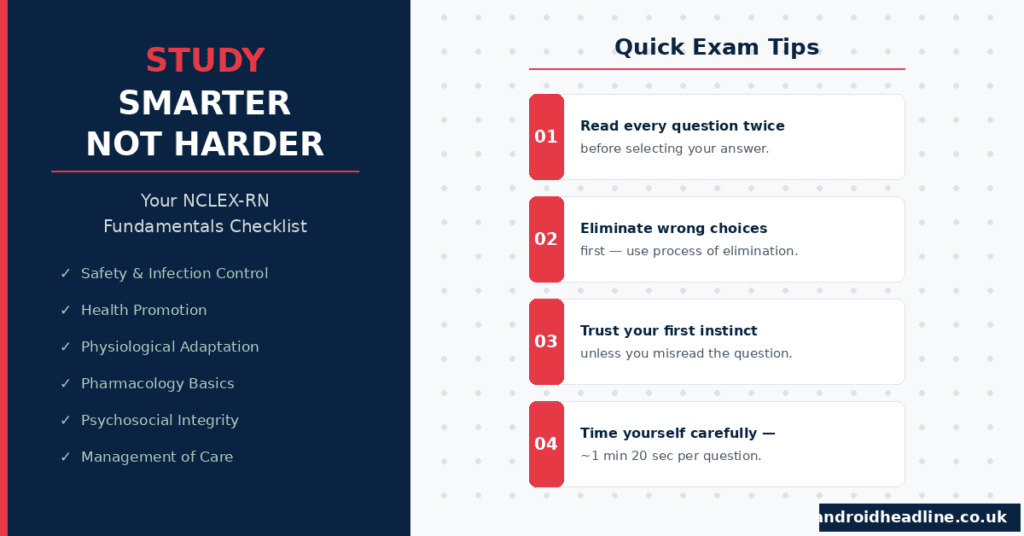
- Simulate real exam conditions. Set a timer for 93 minutes (1 min 20 sec per question). No phone, no notes, no pausing.
- Answer all 70 questions before reviewing anything. Resist peeking at the answers mid-way.
- Analyze every question you got wrong — and every one you guessed on. A lucky correct guess is still a knowledge gap.
- Look for patterns. If you’re missing most of your pharmacology or psychosocial questions, that’s your weak zone. Attack it.
- Re-read the rationale even for correct answers. Knowing why builds the deep clinical reasoning NCLEX tests.
- Repeat the exam 3–5 days later. Without re-reading answers first. You’ll be surprised how much more you retain.
My Personal Study Tip (From Someone Who’s Been There)
When I was studying for boards, I used to just blast through practice exams and feel good about a 70% score. Then my instructor said something that stuck with me: “NCLEX doesn’t care what you memorize. It cares whether you can think like a nurse.” That flipped everything for me. I started reading rationales out loud, talking through the clinical reasoning like I was explaining it to a patient. My scores jumped from 70% to consistently 80%+ within two weeks. Don’t just get the right answer — understand why it’s right.
Complete Nursing Fundamentals Study Guide: Key Topics to Review
Here are the major content areas you should be comfortable with before sitting the full 70-question exam:
Infection Control & Safety
- Hand hygiene (WHO 5 Moments)
- Standard vs. Transmission-Based Precautions
- PPE selection by transmission route
- Fall risk assessment tools (Morse Fall Scale, STRATIFY)
- Fire safety (RACE/PASS)
Vital Signs & Physical Assessment
- Normal ranges by age group
- Orthostatic hypotension assessment
- Oxygen saturation and SpO2 interventions
- Pain assessment scales (Numeric, FACES, FLACC)
Nutrition & Elimination
- Therapeutic diets (low-sodium, diabetic, renal)
- Nasogastric tube care and placement verification
- Bowel and urinary elimination interventions
- Fluid balance and I&O monitoring
Wound Care & Mobility
- Wound assessment and staging (pressure injuries I–IV)
- Positioning and turning schedules
- Range of motion (active vs. passive)
- Assistive device use
Medication Administration
- The 10 Rights of Medication Administration
- Common drug classifications and nursing considerations
- High-alert medications (insulin, anticoagulants, digoxin)
- Reading MAR and avoiding transcription errors
Practice Exam vs. Real NCLEX: What’s Different?
The RN Fundamentals 2016 Practice Exam is a fantastic prep tool, but there are a few differences to keep in mind:
- Next Generation NCLEX (NGN): Since 2023, NCLEX includes new question formats like clinical judgment scenarios and bow-tie questions. You’ll want to supplement this exam with NGN-style practice.
- Adaptive Testing: Real NCLEX uses Computer Adaptive Testing (CAT), meaning the difficulty adjusts to your performance. Practice exams are fixed — but they still build the foundational knowledge you need.
- Passing Standard: NCLEX doesn’t use a percentage score. It uses a logit-based standard. Focus on consistently performing in the high-difficulty question range on practice exams.
For more on NGN formats, check out the NCSBN’s Next Generation NCLEX resource page.
Related Resources You’ll Love
- NCLEX-RN Study Schedule: 8-Week Countdown Plan (Internal link placeholder)
- Top 50 NCLEX Pharmacology Questions With Rationales (Internal link placeholder)
- SATA Questions: How to Tackle Select-All-That-Apply on NCLEX (Internal link placeholder)Final Thoughts
The RN Fundamentals 2016 Practice Exam is one of the most comprehensive free study resources you’ll find for NCLEX prep. With 70 well-constructed questions across every major content domain — from infection control to pharmacology — it covers exactly what you need to feel confident on exam day. Use it as a diagnostic tool, study the rationales deeply, and pair it with our nursing study guide to shore up your weak spots.
You’ve already done the hard work of getting into nursing school. Now let’s make sure you walk out the other side with those letters after your name.
Drop a comment below with your biggest NCLEX struggle right now — I read every single one. And if you found this guide useful, share it with a classmate who’s in the grind with you.
Quick FAQ
Q: Is the RN Fundamentals 2016 Practice Exam still relevant for today’s NCLEX? Yes — core nursing fundamentals haven’t changed significantly. This exam aligns closely with current NCLEX-RN content categories and is excellent for building foundational knowledge.
Q: How many questions are on the RN Fundamentals 2016 Practice Exam? This study guide covers 70 questions with full rationales across all major NCLEX-RN client needs categories.
Q: What’s a passing score on practice exams? Aim for 65–75% on standard practice exams as a baseline. Consistent scores above 75% on difficult question sets indicate strong NCLEX readiness.