
If you’ve been keeping tabs on Aliens: Fireteam Elite 2, you already know the hype is real. The first game built a loyal fanbase of players who just couldn’t get enough of blasting Xenomorphs with friends. So when the sequel started teasing bigger, bolder co-op gameplay, fans (myself included) were pumped.
But here’s the thing — the director recently opened up about why adding 4-player co-op to Aliens: Fireteam Elite 2 isn’t as simple as it sounds. Turns out, going from 3 players to 4 opens up a whole can of worms (or should I say, a whole hive of Xenomorphs). In this post, I’m breaking down exactly what makes this development challenge so significant — and what it means for the final game.
What Did the Director Actually Say?
The creative director behind Aliens: Fireteam Elite 2 didn’t sugarcoat it. In a recent developer interview, they explained that scaling multiplayer co-op from 3 to 4 players isn’t just a math problem — it’s a design overhaul that touches nearly every system in the game.
That might sound like corporate PR talk, but when you dig into the specifics, it makes complete sense.
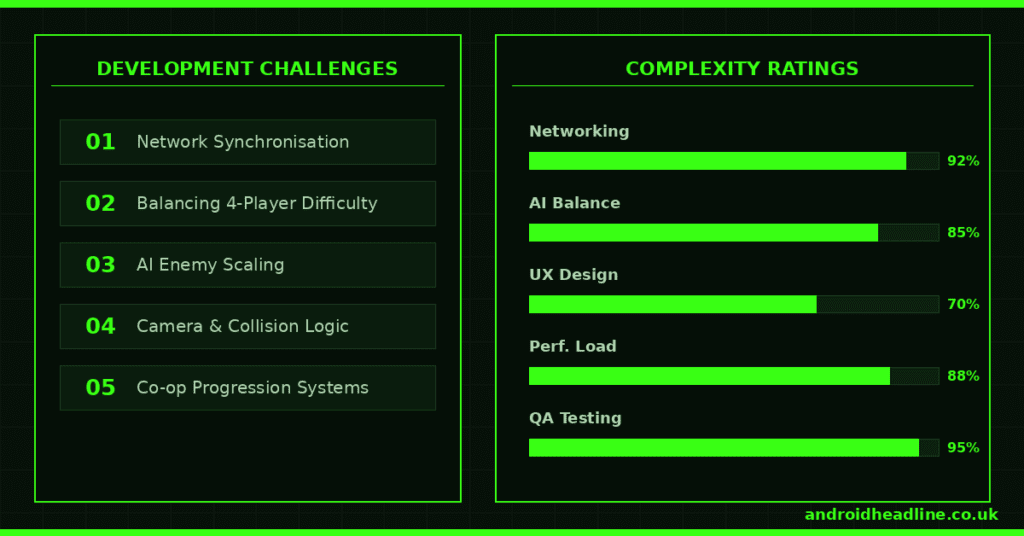
Going from 3-player to 4-player co-op means the team had to revisit:
- How enemies spawn and scale
- How the camera and collision systems behave in tight spaces
- How the difficulty curve is balanced without making things too easy or too brutal
- How server performance holds up under the extra load
The director described it as essentially rebuilding the game’s multiplayer DNA — and they weren’t exaggerating.
Why 4-Player Co-Op Is Genuinely Harder to Build
The Networking Nightmare
Let me be real with you — I’ve spent years reading about game development, and networking is always the villain of the story. Every new player added to an online session multiplies the complexity of keeping everyone’s game in sync.
With 3 players, you’re managing 3 data streams, 3 positions, 3 sets of actions. Add a 4th player and suddenly you’ve got:
- More lag compensation to calculate
- More edge cases where players desync
- More potential for one bad connection to ruin everyone’s session
According to technical insights from Digital Foundry’s game architecture breakdowns, multiplayer games that expand player counts mid-development often face architecture changes that can delay release by months. It’s not a small thing.
Balancing Difficulty for a Bigger Squad
Here’s something I didn’t appreciate until I really thought about it — 4 players fundamentally changes how hard a game feels. Four competent players can make encounters that once felt tense feel trivial. So the devs had to redesign enemy behaviour, spawn rates, and even individual Xenomorph AI routines.
Think about it: if 3 players could just barely handle a swarm, what happens when a 4th player joins and suddenly that swarm is no threat at all? The tension disappears. The horror evaporates. And in an Aliens game, that tension is everything.
The director specifically mentioned that the team had to redesign several encounter zones from the ground up. That’s hours of playtesting, tweaking, and iterating — all just to make sure a 4th player makes things harder, not easier.
Camera and Level Design Headaches
This one surprised me when I first read about it. In a 3-player game, level designers know roughly how much space 3 characters will occupy. Corridors are built with that in mind. Camera systems are tuned for it.
Add a 4th player, and suddenly:
- Corridors feel cramped
- Players clip through each other more often
- The camera has to account for a wider spread of positions
The team apparently had to go back and widen certain sections of existing maps — which cascades into geometry changes, collision updates, lighting recalculations, and more. It’s a domino effect.
Performance Load on Consoles
We’re in an era where games are expected to run smoothly on PS5 and Xbox Series X/S — but also on last-gen hardware for older audiences. Every extra player character adds rendering load, physics calculations, and animation processing.
The director noted that hitting a stable frame rate with 4 active players, full enemy swarms, and particle effects from weapons firing simultaneously was one of the team’s biggest technical targets. They didn’t want to sacrifice visual fidelity just to hit the player count.
My Honest Take on All This
I’ll be straight with you — I was one of the people asking “why not 4 players?” when the original Aliens: Fireteam Elite launched with a 3-player cap. It felt like an arbitrary limitation. “Just add another slot!” I’d say, totally ignoring the fact that I have absolutely zero game development experience.
Reading the director’s explanation genuinely humbled me. The amount of behind-the-scenes work that goes into what seems like a simple feature addition is staggering. I have a new level of respect for what the Cold Iron Studios team is taking on here. If they pull it off cleanly — smooth networking, tight balance, solid performance — it’s going to be a huge win for the sequel.
What This Means for Players Like Us
So what does all this dev talk actually mean for you when you finally sit down to play Aliens: Fireteam Elite 2?
Here’s what to watch for when the game drops:
- Enemy density — If the dev team nailed it, 4-player sessions should feel just as tense as 3-player ones did in the original.
- Network stability — A smooth, lag-free co-op experience will be the clearest sign the backend work paid off.
- Map design — Look for levels that feel built for 4 players, not retrofitted for them.
- Difficulty scaling — The best-case scenario is that higher player counts unlock harder modes, not easier ones.
These are the details that separate a sequel that truly evolves from one that just adds a number to the title.
How Does This Compare to Other Co-Op Games?
It’s worth zooming out for a second. Other beloved co-op shooters have tackled this exact problem:
- Left 4 Dead 2 built its entire design philosophy around 4-player co-op from day one — and it’s still praised for its tension decades later.
- Deep Rock Galactic supports up to 4 players and is frequently cited as one of the best-balanced co-op experiences in recent memory.
- Back 4 Blood, which tried to follow L4D2’s blueprint, received criticism early on for inconsistent difficulty scaling across player counts.
The lesson? Getting 4-player co-op right is genuinely rare. Most games that do it well built their entire foundation around it. Aliens: Fireteam Elite 2 is retrofitting it into a sequel — which is why the director’s honesty about the challenge is actually reassuring. It means they know exactly what they’re up against.
Tips for Getting the Most Out of Co-Op When It Launches
Whether you’re planning to squad up with friends or jump into public lobbies, here are a few things to keep in mind:
- Communicate your roles early — In 4-player squads, class synergy matters even more. Discuss who’s playing what before the mission starts.
- Don’t ignore the game’s challenge modes — These are usually where the difficulty scaling shines brightest.
- Test your connection before long sessions — If one player has a weak connection, everyone suffers. Run a quick speed test.
- Experiment with different squad compositions — 4 players opens up new tactical possibilities. Try combinations that weren’t possible in the original.
For more on co-op gaming strategy, check out our post on How to Build the Perfect Co-Op Squad in Shooter Games (internal link placeholder).
What We’re Still Waiting to Hear
There’s still plenty we don’t know about Aliens: Fireteam Elite 2. The director’s comments about 4-player co-op are a great peek behind the curtain, but fans are still hungry for:
- A confirmed release date
- Full class and weapon details
- Story campaign information
- Cross-play support details
We’ll be covering all of it as it drops. Check out our Aliens: Fireteam Elite 2 Hub Page for the latest updates (internal link placeholder), and don’t miss our earlier breakdown on The Best Co-Op Games of 2025 You Might Have Missed (internal link placeholder).
Conclusion
Look, 4-player co-op sounds like a feature. But as the director made clear, it’s really a complete systems redesign. Networking, AI, level design, performance, balance — all of it changes when you add that 4th seat.
The fact that the team at Cold Iron Studios is being transparent about the challenge is a good sign. It means they’re taking it seriously rather than rushing it to a feature list. And if they get it right? Aliens: Fireteam Elite 2 could be one of the best co-op shooters in years.
I’m keeping my eye on every update between now and launch. If you are too, drop a comment below with your most-wanted feature for the sequel — I’d love to know what you’re hoping for. And if you found this post useful, share it with your squad. They need to know what’s coming.