I’ll be straight with you — when the Garmin Fenix 8 first launched in late 2024, I thought it was impressive but way too expensive for most people. And honestly? I still had that feeling until I started seeing the prices come down through 2025 and into 2026.
Right now, you can pick up the Garmin Fenix 8 47mm AMOLED for prices that would’ve seemed impossible a year ago. So the big question I keep getting asked is: does this drop in price make the Garmin Fenix 8 the best sports watch to buy in 2026, or is the Fenix 9 just around the corner making it a risky bet?
I’ve had this watch on my wrist through rain, mud, and more trail miles than I can count. Here’s everything you need to know.
What’s the Garmin Fenix 8 Actually About?
If you haven’t been following the Garmin lineup, the Fenix 8 was a bit of a landmark release. Garmin merged their Fenix and Epix lines into one family, which means you finally get to pick your screen type — AMOLED or Solar MIP — without giving up any core features.
The result is what a lot of people in the running and hiking world are calling a “no-compromise watch.” And after testing it extensively, I think that’s a pretty fair description.
Key specs at a glance:
- Display: 1.4-inch AMOLED (454×454px, 1,000 nits) or Solar MIP
- Battery: Up to 21 days smartwatch mode; 47 hours in GPS mode
- GPS: Multi-band GNSS (GPS, GLONASS, Galileo, L1+L5)
- Water rating: 40m dive certified (EN13319)
- Storage: 32GB (maps + music)
- New features: Built-in speaker, microphone, LED flashlight, ECG app
- Sizes: 43mm, 47mm, 51mm
The Price Drop: How Much Has It Actually Come Down?
This is the part that probably brought you here. When the Fenix 8 launched, the base AMOLED model started at $999 — which was already $100 more than the comparable Epix Pro Gen 2. That stung.
By mid-2026 though, you’re regularly seeing deals that knock the price down significantly. In the UK, it’s been dropping to around £618–£799 from its original £900+ launch price. In the US, street prices have become much more competitive as retailers move inventory ahead of whatever Garmin announces next.
Is it the lowest price ever? Quite possibly, yes. And that changes the value conversation completely.
GPS & Navigation: Where It Really Shines
I’ll be honest — this is the area where the Fenix 8 just destroys the competition. I tested it against my old Garmin GPSMAP 67 and pre-verified GPX routes across multiple trail systems, and the multi-band GNSS barely put a foot wrong.
What I really love is ClimbPro. You get a breakdown of every upcoming climb — gradient, distance, estimated time — which is something I use on every long run now. It completely changed how I pace myself on big ascents.
The AMOLED screen makes the full-colour topographic maps pop in a way that MIP displays just can’t match. On a bright sunny day at 1,000 nits, it’s absolutely readable without shielding the screen with your hand.
Battery Life: Surprisingly Good for AMOLED
A lot of people assume AMOLED kills battery life. The Fenix 8 is the watch that’s changed that assumption for me.
In real-world use — tracking a 90-minute trail run, checking notifications, using GPS — I was getting 5 to 6 days between charges. Not the full 21-day spec, obviously, but still way better than any Apple Watch or Samsung Galaxy Watch can dream of.
For multi-day backpacking? I genuinely stopped worrying about battery. That’s a first for me with an AMOLED watch.
The Features That Actually Matter Day-to-Day
The LED Flashlight Is Surprisingly Brilliant
I didn’t expect to use this much, but the flashlight has become one of my most-used features. It’s genuinely bright — way better than older Garmin models — and double-clicking the top-left button activates it instantly. Pre-dawn starts and post-sunset trail returns just got a lot safer.
Voice Commands Work (Mostly)
The built-in speaker and mic let you take phone calls, set timers by voice, and leave voice notes on trails. It’s genuinely useful for leaving location notes mid-run. That said, in loud outdoor environments, you do need to speak pretty clearly.
Sleep & Health Tracking Is Excellent
I compared the Fenix 8’s sleep data against my Oura Ring, and I was genuinely impressed. Overall sleep accuracy is very high, and the heart rate monitoring averaged just a 1.4 bpm variance against a chest strap during active testing. For most athletes, this replaces the need for a separate HR monitor.
Honest Downsides Worth Knowing
No watch is perfect, and I’d be doing you a disservice if I skipped over the rough edges:
- Aggressive auto-dim at night: The screen dims more aggressively than older models and you can’t turn it off. It’s annoying for those 3am bathroom trips. The workaround is to use white data fields on your watch face.
- Button feel has changed: The new inductive buttons are more watertight (needed for the 40m dive rating), but they have less tactile feedback than older Garmin buttons. With gloves on in cold weather, you notice the difference.
- No LTE: Some competitors are offering cellular connectivity now. Garmin still doesn’t on the Fenix 8 standard model.
- Proprietary charging cable: Same complaint since the Fenix 5. You’ll want a backup cable.
Should You Wait for the Garmin Fenix 9?
This is the elephant in the room. Garmin is widely expected to announce the Fenix 9 in Q3 or Q4 of 2026. If that happens, the Fenix 8 price will likely drop another $150–$200 — making it arguably the best value in Garmin’s history.
My honest advice? If you need a watch right now, buy the Fenix 8. It’s outstanding. If you can wait until late 2026, hold off and see what the Fenix 9 brings — and then grab the Fenix 8 at its post-launch discount if the new model doesn’t wow you.
For anyone upgrading from a Fenix 5 or 6, or coming from a non-Garmin watch, this is a no-brainer at current prices.
Fenix 8 vs Fenix 7 Pro: Is the Upgrade Worth It?
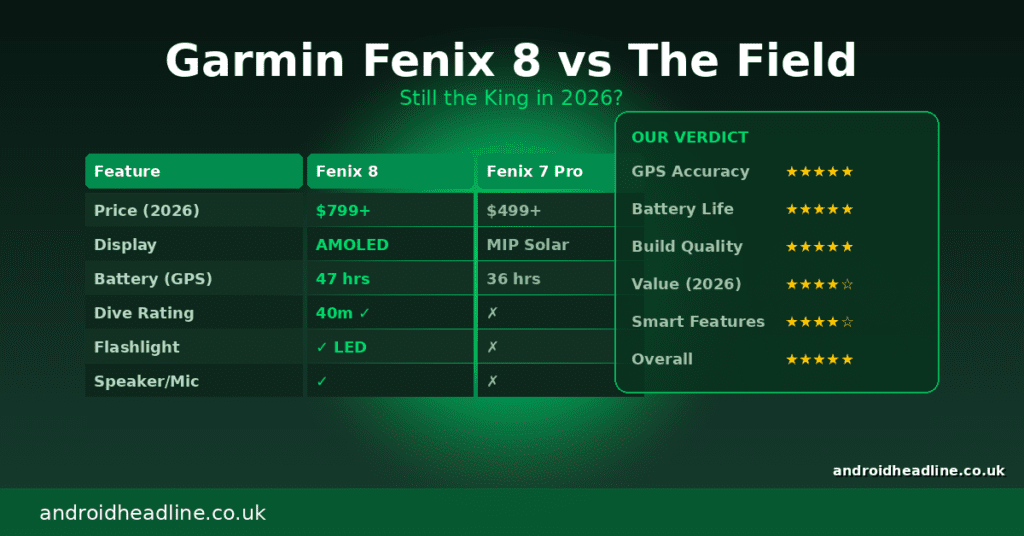
A lot of people I talk to are sitting on a Garmin Fenix 7 Pro and wondering if they should jump. Here’s the honest breakdown:
Upgrade if you want: the AMOLED display, the built-in flashlight, dive certification, voice commands, or better battery life.
Skip the upgrade if: you’re happy with your Fenix 7 Pro’s screen and you’re not a diver. The 7 Pro is still an excellent watch and does 90% of what the Fenix 8 does at a lower price.
If you want to compare your other options, our best Garmin watches of 2026 guide has the full breakdown across every budget.
Final Verdict
The Garmin Fenix 8 in 2026 is as close to a perfect outdoor GPS watch as anything I’ve ever worn. The GPS is class-leading, the AMOLED display is gorgeous, the battery life punches way above what you’d expect, and the dive certification opens up a whole new use case.
At launch prices, it was a tough sell. At 2026 sale prices? It’s genuinely compelling.
Rating: 4.8/5 — One of the best sports watches ever made, now at a price that actually makes sense.
FAQ
Q: Is the Garmin Fenix 8 worth buying in 2026? A: Yes, especially at current sale prices. The Fenix 8 offers best-in-class GPS, an AMOLED display, 47-hour GPS battery life, and 40m dive rating. It’s outstanding value compared to its 2024 launch price.
Q: What is the Garmin Fenix 8 price in 2026? A: The Fenix 8 47mm AMOLED starts around $799–$999 in the US and £618–£789 in the UK depending on the retailer and any active sales.
Q: Should I wait for the Garmin Fenix 9? A: If you need a watch now, buy the Fenix 8 — it’s excellent. If you can wait until late 2026, the Fenix 9 announcement may push Fenix 8 prices even lower, making it an even better deal.
Q: How long does the Garmin Fenix 8 battery last? A: Up to 21 days in smartwatch mode and 47 hours with GPS active. In real-world use with daily activity tracking, expect 5–6 days between charges.
Q: Does the Garmin Fenix 8 have a speaker? A: Yes — the Fenix 8 features a built-in speaker and microphone for phone calls, voice commands, and voice note recording. It’s a first for the Fenix series.