I’ll be upfront with you: I went down a rabbit hole trying to answer this question, and I came out the other side more confused than when I started. If you searched “what is Merfez,” you’ve probably had the same experience.
So instead of pretending I have a neat answer, I’m going to walk you through exactly what’s out there, why it’s such a mess, and how to protect yourself the next time a random word takes over your search results like this.
So, What Is Merfez, Really?
Here’s the short version: there’s no verified company, product, or place officially called Merfez.
I looked for an official website, a business registration, a news article from a real outlet, anything. I didn’t find one. What I found instead were dozens of blog posts, all published within the last few months, all claiming to explain “Merfez” — and almost none of them agree with each other.
One site calls it a content platform for tech and lifestyle articles. Another describes it as a productivity method with three “pillars.” A third says it’s a travel destination somewhere in an unnamed “region or country.” A fourth calls it an AI tool for building websites. That’s not a brand with a fuzzy identity — that’s a red flag.
Why Are There So Many Conflicting Definitions?
This part I can actually explain, because it’s a pattern I recognize.
It Looks Like a Manufactured Keyword
Every so often, a made-up word starts showing up across dozens of low-effort blogs at the same time, each one offering a totally different “definition.” This usually isn’t organic. It’s a known SEO trick: someone (or some automated tool) invents an unusual, brandable-sounding word, then a wave of content sites — often the same handful of networks — race to publish “explainer” articles for it before anyone else does.
Why bother? Because a brand-new term has zero competition in search results. Even a thin, low-quality article can rank on page one for a week or two, just long enough to grab some clicks or ad views.
AI Has Made This Trend Worse
I’d also bet a good chunk of these “Merfez” articles were drafted with AI and published with little to no editing. You can kind of tell — the sentences repeat themselves, the paragraphs restate the same idea three different ways, and nobody quotes a real source or a real person.
This isn’t just my hunch. Google has been actively working to catch and demote exactly this kind of content. Its Helpful Content system is built to reward pages made for real readers and push down <cite index=”12-1″>content where visitors don’t come away with a satisfying experience</cite>. Search Engine Land has also tracked cases of publishers using AI to mass-produce cheap articles that briefly rank well, comparing it to the old-school “content farms” Google tried to wipe out years ago (searchengineland.com).
What I Noticed When I Actually Dug Into It
Here’s my honest take, for what it’s worth: the fastest way to spot one of these manufactured keyword trends is to open five or six articles on the same term in different tabs and skim just the first two sentences of each.
I did that with “Merfez,” and it took about four minutes to see the pattern. If real writers with real experience had written these, they wouldn’t contradict each other on something as basic as what the thing even is. That inconsistency is the tell every time.
How to Vet an Unfamiliar Brand or Keyword Yourself
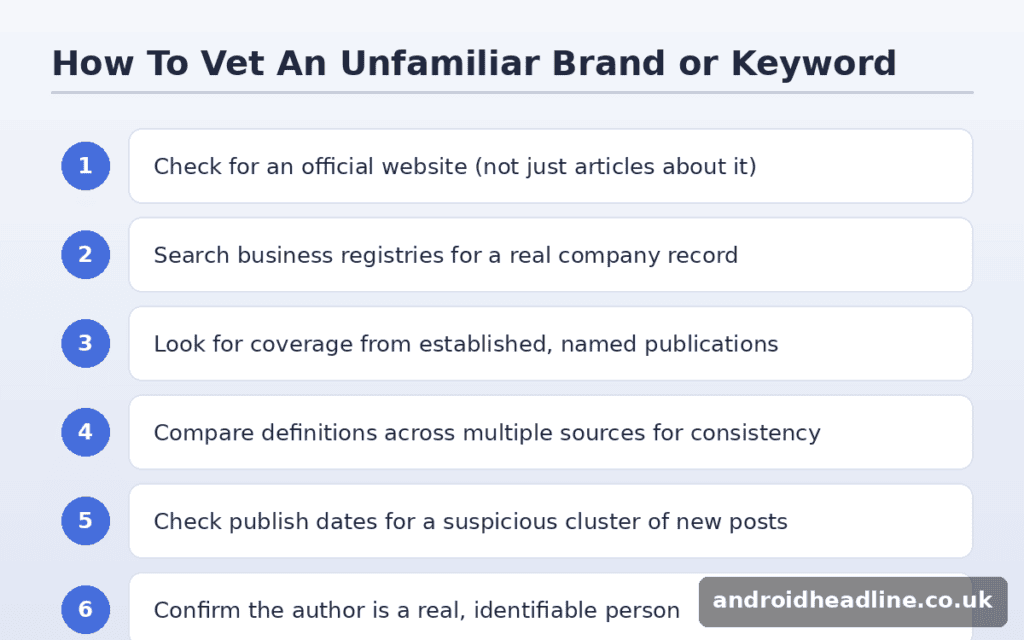
Next time a strange new term shows up in your search results, here’s the quick checklist I actually use:
- Check for an official website. Not a blog about it — an actual site run by the company or brand itself, with real contact info.
- Search business registries. A real company usually shows up somewhere official, depending on the country.
- Look for coverage from established outlets. A genuine product or brand tends to get mentioned by at least one recognizable publication, not just a string of unrelated blogs.
- Compare definitions across sources. If five articles give you five different explanations, that’s a strong signal nobody actually knows what they’re talking about.
- Check publish dates. A cluster of near-identical articles all published within days or weeks of each other is a classic sign of a coordinated content push.
- Look for an author with a real name and background, not just a generic byline like “Team” or “Editor.”
None of this takes more than a few minutes, and it’ll save you from repeating unverified claims as fact — something I try hard to avoid here.
Should You Trust What You Read About Merfez?
Honestly? Not yet. Until an official source — a real website, a registered business, or credible press coverage — actually confirms what Merfez is, I’d treat every existing article about it (including the more confident-sounding ones) as speculation dressed up as an answer.
If that changes and something legitimate does surface under this name, I’ll update this post. That’s a promise I try to keep with every “mystery term” piece I write.
Wrapping This Up
Here’s the honest recap: “Merfez” doesn’t have a confirmed, official meaning right now. It’s most likely a manufactured or trending keyword that a batch of content sites jumped on, each inventing its own version of an answer. The smartest move is to stay skeptical of any single article — mine included — until a verifiable source backs it up.
Have you run into “Merfez” somewhere else, or spotted a similar mystery keyword trending lately? I’d love to hear about it in the comments — and if this saved you from falling down the same rabbit hole I did, feel free to share it with a friend who’s just as confused.