I’ll be honest — the first time I heard the term AICOT, I thought someone had made a typo. It turns out, it’s one of the most quietly important ideas in tech right now. AICOT — short for AI-Chip-on-Thing — refers to a new wave of adaptive AI hardware that puts intelligent processing power directly onto physical devices, from your phone to a traffic camera to a medical sensor.
The big promise? Your gadgets stop depending on the cloud for every smart decision. They start thinking — and adapting — on their own. If you’ve ever wondered why your phone’s face recognition keeps getting faster, or why some smart home devices still work even when your Wi-Fi goes down, adaptive AI hardware is exactly why. Let’s dig in.
What Is AICOT, Really?
AICOT isn’t a single product or brand. Think of it more like a design philosophy — the idea that AI capabilities should be built into hardware at the chip level, rather than bolted on as software running in some distant data center.
Traditional AI processing follows a simple path: your device collects data, ships it to the cloud, waits for a response, and then acts. That works fine… until there’s latency, privacy concerns, or simply no internet connection. AICOT chips flip that model. They run AI models locally, directly on the device, and they’re designed to adapt over time.
The “adaptive” part is what really excites me. These chips don’t just execute fixed instructions. They can tune their own processing priorities based on what they’re actually being used for.
The Three Pillars of Adaptive AI Hardware
- On-device inference: AI decisions happen locally, without sending data to external servers.
- Dynamic power management: The chip scales its energy use based on task complexity — saving battery during low-demand moments.
- Continuous model optimization: The hardware subtly refines how it runs AI models over time, improving efficiency without needing a software update.
Why This Matters Right Now
We’re at a genuine inflection point. For the past decade, most “AI features” in consumer products were really just clever cloud computing. Your smart speaker wasn’t smart — it was a microphone with a very fast internet connection.
That’s changing fast. Companies like Qualcomm, Apple, and a growing roster of specialist chip designers (think Hailo, Syntiant, and Kneron) are racing to embed true AI inference engines into everyday hardware. Apple’s Neural Engine, for instance, now handles billions of operations per second — entirely offline.
AICOT-style thinking is what’s driving this. The question isn’t just can we run AI on a device? — it’s can the device get smarter the more it’s used?
Real-World Examples Worth Knowing
Smartphones: Modern flagships use adaptive AI chips to improve camera performance in real time. The chip learns which scenes you photograph most and pre-loads those processing routines.
Healthcare wearables: Adaptive AI hardware in devices like advanced ECG monitors can detect irregular heart rhythms without uploading your personal health data anywhere — a huge win for privacy.
Industrial IoT: On factory floors, AICOT-enabled sensors identify equipment faults in milliseconds. No cloud round-trip. No delay. Faster intervention.
Autonomous vehicles: Edge AI chips in cars process camera feeds locally, enabling split-second decisions that simply can’t wait for a server response.
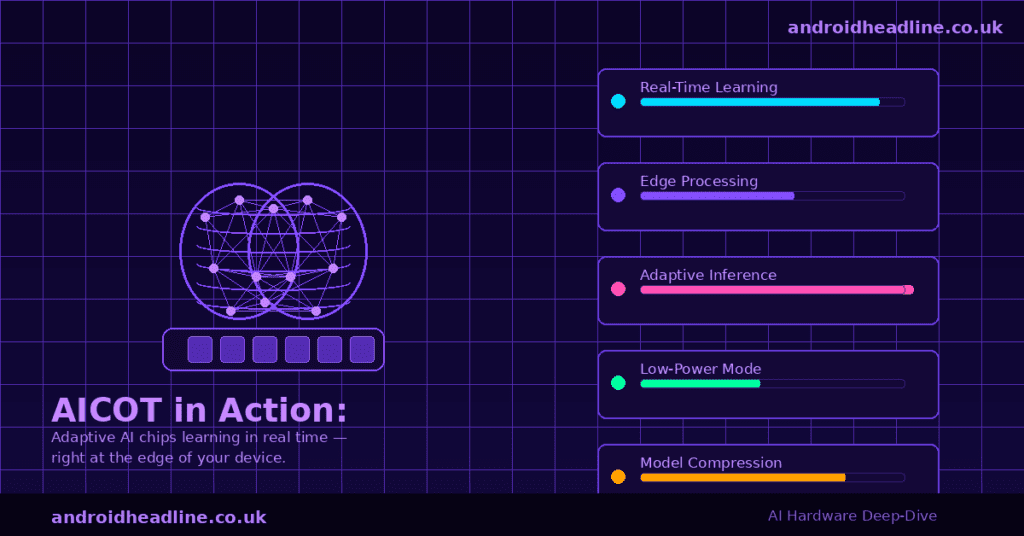
How Adaptive AI Hardware Actually Works
Let me break this down simply, because it can sound intimidating.
Inside an AICOT-style chip, there are typically three core components working together:
- A neural processing unit (NPU): This is the muscle. It’s a dedicated processor built specifically to handle the matrix math that AI models rely on — much more efficiently than a general-purpose CPU.
- A memory architecture optimized for AI: Traditional chips shuttle data back and forth from memory constantly, which wastes time and energy. Adaptive AI chips use in-memory computing or tightly integrated cache to keep AI data close to where it’s processed.
- An adaptive scheduler: This is the smart bit. It monitors how the chip is being used and dynamically reassigns processing resources. Watching a video? Dial down the AI inference engine. Running real-time object detection? Ramp it back up.
The result is a chip that doesn’t just execute AI — it manages AI intelligently.
A Quick Tip If You’re a Developer
If you’re building applications that might run on AICOT-capable hardware, here’s a practical starting point:
- Use model formats designed for edge deployment — TensorFlow Lite, ONNX Runtime, or CoreML (for Apple silicon) are your best friends.
- Profile your model’s memory footprint before assuming it’ll run well on-device. Smaller models (sub-10MB) generally adapt best to constrained hardware.
- Look into quantization — converting your model from 32-bit floats to 8-bit integers. You’ll often lose less than 1% accuracy while gaining huge efficiency benefits.
My Take: Why I Think AICOT Is the Sleeper Story of the Decade
I’ve been following AI hardware trends for a while now, and I’ll admit — most of the excitement gets funneled toward big language models and flashy chatbots. Totally understandable. But I think the real quiet revolution is happening at the chip level.
When I first held one of the new generation AI-enabled earbuds that process noise cancellation with an on-device neural model — no cloud, no lag, just seamless audio — something clicked for me. This is what ambient intelligence looks like. It doesn’t announce itself. It just works. And it gets better over time.
AICOT represents a shift from AI as a service to AI as infrastructure. That shift is going to touch every device category we use. I genuinely believe in five years, asking “does this device have AI hardware?” will feel as odd as asking “does this laptop have Wi-Fi?”
The Challenges (Because Nothing’s Perfect)
It’s worth being honest here — adaptive AI hardware isn’t without its hurdles.
Cost: Custom AI silicon is expensive to design and manufacture. While costs are falling, premium adaptive chips still command a price premium that trickles down to consumers.
Security: Running AI models locally means those models live on the device and could, in theory, be extracted or tampered with. Hardware-level security enclaves (like Apple’s Secure Enclave) help, but it’s an evolving challenge.
Standardization: Right now, there’s no universal standard for how AICOT-style chips are programmed or optimized. That means developers often have to build separate versions of their AI features for different hardware platforms.
Industry bodies like the MLCommons group (mlcommons.org) are actively working on AI hardware benchmarks and standards — worth bookmarking if you’re a developer or engineer in this space.
What’s Coming Next in Adaptive AI Hardware?
The near-term roadmap is genuinely exciting. Here are a few trends I’m watching closely:
- Neuromorphic chips: Inspired by how biological brains work, these chips process information using spikes of energy rather than continuous signals. Companies like Intel (with its Loihi chip) are making real progress here.
- Photonic AI processors: Using light instead of electricity to perform calculations. Theoretically much faster and far more energy-efficient.
- AI-augmented memory: Chips where the RAM itself can perform some AI computation, dramatically reducing the bottleneck between data storage and processing.
Conclusion
AICOT and adaptive AI hardware might not make headlines the way a new chatbot does, but they’re arguably more transformative in the long run. They’re changing the fundamental relationship between our devices and artificial intelligence — from something we access remotely to something embedded in the tools we use every day.
Whether you’re a tech enthusiast, a developer, or just someone curious about where your smartphone’s intelligence actually comes from, I hope this gave you a clearer picture. The future isn’t just AI in the cloud — it’s AI in everything.