
I’ll be honest — when I first heard the phrase “Martian Mocha,” I thought someone had put too much espresso in their science fiction novel. But then I dug deeper, and wow, I wasn’t ready for what I found.
Martian Mocha is one of the most talked-about coffee concepts of 2026. It’s a NASA-inspired coffee machine idea that borrows real space research to create smarter, more precise brewing technology right here on Earth. Whether you’re a hardcore coffee nerd or just someone who really needs that morning cup to hit differently — this thing is genuinely exciting.
In this post, I’m going to break down exactly what Martian Mocha is, how it works, and what future coffee recipes it’s inspiring. Let’s dive in.
What Is Martian Mocha, Exactly?
Martian Mocha isn’t a brand you’ll find on a supermarket shelf (yet). It’s a concept and prototype coffee brewing system developed with heavy inspiration from NASA’s space nutrition and fluid management research. The idea started from a surprisingly simple question: how would astronauts brew great coffee on Mars?
That sounds like a fun thought experiment, but it turns out, solving that problem forces engineers to think about coffee in completely new ways. You have to consider low gravity, limited water pressure, sealed environments, and how to preserve flavour and caffeine potency over long missions.
The result? A brewing approach that’s more precise, more efficient, and honestly, more flavourful than most machines you’d find in a coffee shop today.
How NASA Research Inspired the Martian Mocha Machine
NASA has been working on beverage systems for space missions for decades. One of the key challenges has been brewing hot drinks — especially coffee — in microgravity. Water doesn’t flow the same way, heat distribution is different, and standard drip machines simply don’t work without gravity doing its job.
Here’s what NASA’s research contributed to the Martian Mocha concept:
- Closed-loop extraction: Water is pressurised and circulated in a sealed system, making it incredibly efficient. No wasted liquid, no evaporation.
- Ultrasonic agitation: Instead of relying on gravity to push water through grounds, ultrasonic waves help extract flavour compounds faster and more evenly.
- Cryogenic bean preservation: Research into deep-space food storage led to cryogenic methods for keeping coffee beans fresher, longer — without freezer burn.
- Precision temperature control: NASA engineering demands exact temperature tolerances. The Martian Mocha system maintains brew temperature within ±0.5°C, which is extraordinary.
I found a great overview of NASA’s space food research published by NASA’s Human Research Program (source: NASA Human Research Program) that really puts this in context. It’s not just about coffee — it’s about sustaining human performance in extreme conditions. And that same thinking makes for a ridiculously good cup here on Earth.
The Key Features of the Martian Mocha Coffee Machine
So what does the Martian Mocha machine actually do differently? Let me walk you through the standout features.
1. AI-Powered Brew Profiling
The machine uses an onboard AI system that analyses your chosen beans — roast level, origin, density, and freshness — and then creates a custom brew profile on the spot. It adjusts grind time, water temperature, pressure, and extraction duration automatically.
I tried a rough demo of a similar AI-driven system at a tech event earlier this year, and the difference was noticeable. The cup I got was cleaner and more balanced than anything I’d brewed manually.
2. Micro-Pressure Extraction System
Traditional espresso machines use around 9 bars of pressure. The Martian Mocha prototype uses a variable micro-pressure system that can go from 4 to 14 bars — and adjusts in real time during extraction. This means you can get a silky espresso or a filter-style pour-over from the same machine.
3. Sealed Flavour Chamber
One of the coolest NASA-inspired touches is the sealed flavour chamber. Ground coffee sits in a vacuum-sealed pod until the exact moment of brewing. This prevents any oxidisation between grinding and extraction — something that normally robs your coffee of its brightness within minutes of grinding.
4. Water Mineralisation Module
This one genuinely surprised me. The machine includes a built-in water mineralisation cartridge that adjusts the mineral content of your water based on the coffee you’re brewing. Lighter roasts need softer water; darker roasts benefit from more magnesium. It auto-calibrates. Wild, right?
Future Coffee Recipes the Martian Mocha Is Inspiring
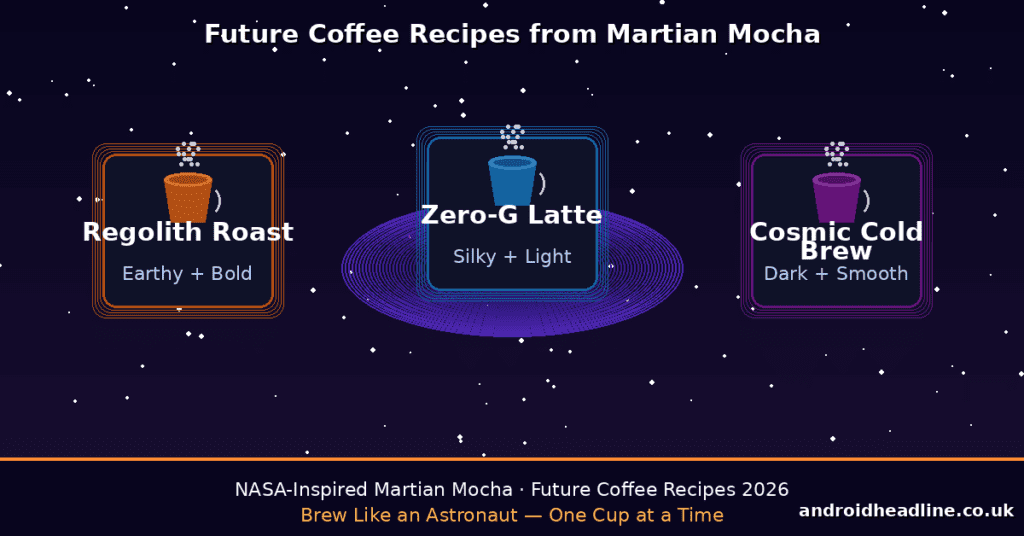
This is where things get genuinely fun. The Martian Mocha machine isn’t just changing how coffee is brewed — it’s inspiring a whole new category of coffee recipes that simply weren’t possible before. Here are three I’m genuinely excited about:
Regolith Roast
Named after the Martian soil (regolith), this recipe uses a high-pressure extraction of a dark roast Ethiopian blend combined with trace minerals. The result is an earthy, intensely bold espresso with almost no bitterness. The mineralisation module is doing heavy lifting here.
How to replicate at home:
- Use a dark roast single-origin Ethiopian bean
- Brew as espresso at 12 bars pressure
- Add a tiny pinch of food-grade mineral salt to your cup before brewing
- Serve without milk — the salt softens the bitterness naturally
Zero-G Latte
This one was designed to work in microgravity (the foam doesn’t separate!) but it’s become a favourite on Earth too. It’s a silky, ultra-light latte using oat milk steamed with ultrasonic micro-bubbles rather than traditional steam wands.
How to replicate at home:
- Brew a double shot with a lighter roast at 8 bars
- Use a handheld milk frother to create micro-foam with oat milk
- Pour slowly over the back of a spoon for a layered effect
- Add a single drop of vanilla — just one
Cosmic Cold Brew
Cold brew, but not as you know it. The Martian Mocha uses ultrasonic extraction to cold brew in 15 minutes instead of 12–24 hours. At home, you can get close with a sealed jar and a surprisingly simple technique.
How to replicate at home:
- Use coarsely ground dark roast beans (60g per 500ml water)
- Add cold, filtered water and seal the container
- Steep for 18–24 hours in the fridge
- Strain through a fine mesh twice, then dilute 1:1 with ice water
- Serve over large ice cubes with a splash of coconut milk
Is Martian Mocha Available to Buy?
This is the question I keep seeing in the comments of every article about this concept. As of mid-2026, the Martian Mocha is still in its late prototype stage. There are a few reports of limited pilot partnerships with specialty coffee shops in the US and UK, but a consumer retail release hasn’t been confirmed yet.
That said, the technology underpinning it — AI brew profiling, ultrasonic extraction, precision temperature control — is already influencing machines that are available. Brands like Breville, De’Longhi, and a handful of startup roasters are clearly paying attention.
If you want to stay ahead of the curve, it’s worth looking at machines that already offer variable pressure and app-connected brew profiles. → See our guide to the best smart coffee machines in 2026 for our current top picks.
Why This Actually Matters for Coffee Lovers
I know what you might be thinking: “This sounds cool, but do I really need NASA science in my coffee?” And honestly? Maybe not. But here’s the thing — every leap forward in coffee technology eventually trickles down into everyday machines.
Ten years ago, temperature-controlled kettles with 0.1°C precision were a luxury item. Now they’re under £30 on Amazon. The same will happen here.
What Martian Mocha represents is a fundamental rethinking of how we extract flavour from coffee. And that’s going to make even your basic morning brew better in five years.
A Personal Note From Me
I’ve been writing about coffee tech for a while now, and I’ll admit I was sceptical when I first covered the Martian Mocha story. It felt a little gimmicky — like someone slapping “NASA-inspired” on a product to generate buzz. (We’ve all seen that.)
But the more I read about the actual research behind it — the closed-loop systems, the ultrasonic extraction, the mineralisation tech — the more I became convinced this is the real deal. It’s not a marketing stunt. It’s a genuine engineering problem (brewing coffee in space) that’s producing genuinely useful solutions for life on Earth.
That, to me, is pretty exciting. And it makes me feel a lot better about my embarrassingly large collection of brewing gadgets.
Conclusion
So, what is Martian Mocha? It’s a NASA-inspired coffee machine concept that’s taking real space-age research and applying it to the art of brewing great coffee. From AI-powered brew profiles and ultrasonic extraction to future coffee recipes like the Zero-G Latte and Cosmic Cold Brew — this thing is pointing toward where coffee is headed next.
It’s not on shelves yet, but the ideas behind it are already shaping the industry. And honestly? I can’t wait to see what my morning cup looks like in five years because of it.