I’ll be honest — I never thought I’d see the day when my phone could get a signal in the middle of nowhere, without a cell tower in sight. But here we are in 2026, and SpaceX Starlink Mobile Network is making that dream a reality for millions of people around the world.
If you’ve been hearing buzz about Starlink’s mobile service and wondering what’s actually happening, you’re in the right place. I’ve been following this story closely, and in this post I’m going to break down the latest reports, the features you can expect, what experts are saying, and whether this is truly the next big thing in mobile connectivity. Let’s dive in.
What Is the SpaceX Starlink Mobile Network?
Before we get into the 2026 updates, let me give you a quick refresher. Starlink is SpaceX’s satellite internet service that uses a massive constellation of low-Earth orbit (LEO) satellites to beam internet connectivity directly to devices on the ground.
The Starlink Mobile Network — also known as Starlink Direct to Cell — takes this a step further. Instead of needing a special Starlink dish at home, this service lets standard smartphones connect directly to Starlink satellites in the sky. No new hardware. No special SIM. Just your everyday phone.
That’s a huge deal. And in 2026, it’s moving from limited beta into something much bigger.
Latest Reports: What’s Happening in 2026?
Rapid Carrier Expansion
One of the biggest stories right now is carrier partnerships. SpaceX has been signing deals with mobile operators around the world to offer Starlink-powered coverage as a supplement to traditional networks. T-Mobile in the US has been a major partner, and similar deals are being rolled out across Europe, Asia, and parts of Latin America.
Reports suggest that by mid-2026, Starlink’s Direct to Cell service is available in over 40 countries through partner carriers. That’s a jump from just a handful of pilot markets at the end of 2024.
Satellite Count Is Soaring
SpaceX has been launching satellites at a breathtaking pace. The company now operates well over 6,000 satellites in orbit, with the Direct to Cell-capable fleet growing consistently. More satellites means better coverage, lower latency, and higher capacity for users on the ground.
Text, Data, and Now Voice
Early versions of Starlink Mobile only supported text messaging in dead zones. That was already impressive — getting an SMS through in a canyon or on a remote hiking trail? Game-changing. But 2026 is seeing data connectivity roll out more broadly, with voice calls expected to follow later in the year. Experts note that full voice support is technically complex but SpaceX is on track.
Expected Features of Starlink Mobile Network 2026
Here’s what’s either already live or strongly expected based on the latest technical briefings and industry analysis:
1. Works with Standard Smartphones No special device needed. If your phone supports LTE Band 53 (and many newer phones do), you may already be compatible.
2. Dead Zone Coverage This is the killer feature. Anywhere your carrier has no signal — mountains, rural roads, open water — Starlink steps in automatically.
3. SMS First, Data Second, Voice Later Text messaging is the most mature feature. Broadband data in remote areas is rolling out through 2026. Voice is the final frontier.
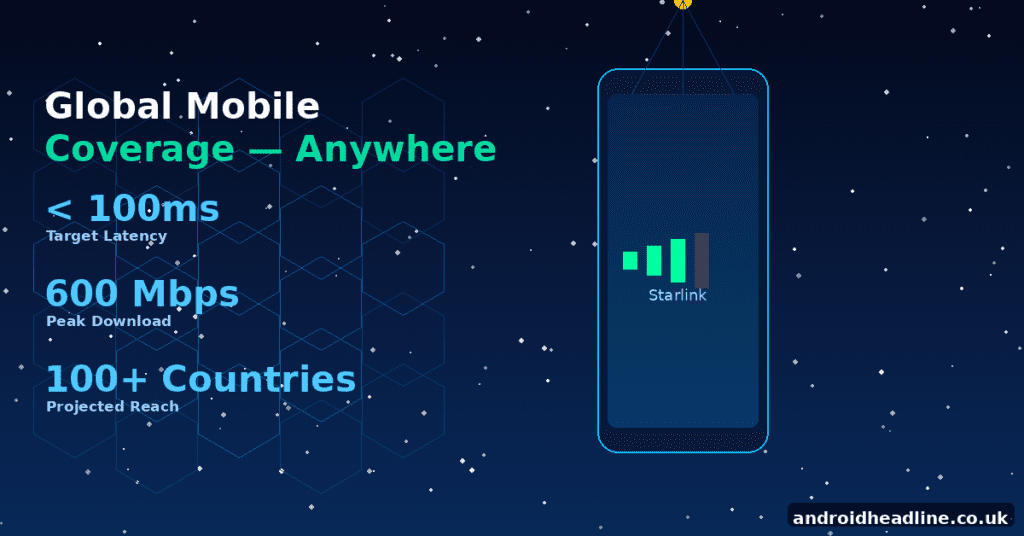
4. Low Latency Improvements Early reports quoted latency around 100ms over satellite. That’s higher than 4G LTE but workable for messaging and basic browsing. SpaceX is working to push this down.
5. No Extra Hardware Unlike the home Starlink dish, Direct to Cell needs nothing extra. This is what makes mass adoption realistic.
6. Emergency SOS Capabilities Expect integration with emergency services in more regions — a potentially life-saving feature for hikers, sailors, and rural residents.
Expert Analysis: Is This the Future of Mobile?
I asked myself this question a lot while researching this post. And the expert consensus is cautiously optimistic — but with some important caveats.
What analysts are saying:
Telecom experts point out that Starlink Mobile isn’t meant to replace your carrier’s 5G network. Think of it as a safety net. In dense urban areas, 5G is still faster, more reliable, and cheaper. But in the 70% of the Earth’s surface that traditional carriers simply don’t cover — oceans, deserts, mountain ranges — Starlink is genuinely unmatched.
A widely cited analysis from industry researchers suggests that by 2027, satellite-assisted mobile connectivity could add an additional 1.5 billion people to some form of reliable data coverage for the first time. That’s not a small thing. That’s transformative.
On the flip side, critics raise fair concerns: capacity limits, potential data throttling in high-demand areas, and pricing that currently makes this more of a premium add-on than a mass-market product.
External Reference: According to SpaceX’s own technical documentation and roadmap presentations (available at spacex.com), the Direct to Cell service is designed to complement existing LTE networks, not replace them.
My Personal Take
I remember a camping trip a few years back where a friend twisted her ankle badly on a trail. We were miles from the nearest road and had zero signal. We were lucky — we found our way back before dark. But I kept thinking: what if it had been worse?
That experience made me genuinely emotional when I first read about Starlink Mobile’s emergency features. Technology that can reach you anywhere on Earth isn’t just cool — it can save lives. That’s the thing that gets me excited about 2026 beyond the specs and the pricing debates.
How to Get Access to Starlink Mobile in 2026
If you want in on this, here’s a practical step-by-step guide:
- Check if your carrier is a Starlink partner. T-Mobile, Optus (Australia), Rogers (Canada), and a growing number of global carriers are already enrolled.
- Verify your phone is compatible. Look for LTE Band 53 support in your phone’s specs — this is the key requirement for Direct to Cell.
- Enroll through your carrier app. Most partner carriers are activating the feature automatically or via a simple opt-in toggle in your account settings.
- Enable satellite messaging in your phone settings. On supported Android and iOS devices, there’s a setting to allow satellite-assisted connectivity.
- Test it in a low-signal area. Head somewhere rural and check if your status bar shows a satellite connection indicator.
Note: Pricing varies by carrier and region. Some are bundling it into existing plans for free. Others charge a small add-on fee. Worth checking your carrier’s website directly.
Pricing: What Does Starlink Mobile Cost?
Pricing is carrier-dependent, but here’s the general picture in 2026:
- Basic satellite texting: Often included free with existing plans (as a dead-zone supplement)
- Satellite data add-on: Typically $5–$15/month through partner carriers
- Standalone Starlink service (for rural broadband, not Direct to Cell): Starts around $120/month for the residential plan
These prices are moving targets as competition heats up — Apple’s Emergency SOS via satellite (powered by Globalstar) and AST SpaceMobile are both pushing SpaceX to keep costs competitive.
Challenges and Limitations to Know About
I don’t want to oversell this. Here are real limitations you should be aware of:
- Speeds in beta areas are modest. Don’t expect Netflix streaming in a dead zone yet. Basic messaging and low-bandwidth data is the realistic promise right now.
- Weather can affect performance. Heavy rain and cloud cover can impact signal, especially at lower elevation angles.
- Not available everywhere yet. Regulatory approvals are still pending in some countries. Coverage maps can be misleading.
- Battery drain. Satellite connectivity typically uses more power than standard LTE. Keep that in mind on long outdoor trips.
The Bottom Line
The SpaceX Starlink Mobile Network in 2026 is genuinely exciting — and not just for tech nerds. It’s solving a real, stubborn problem: the fact that billions of people still lose connectivity the moment they step outside a city.
Is it perfect? No. Is it the silver bullet that replaces 5G? Definitely not. But as a safety net — a layer of always-there, anywhere-on-Earth connectivity — it’s one of the most meaningful tech developments I’ve seen in years.
Whether you’re a traveler, a remote worker, someone who lives in a rural area, or just a person who’s been stranded without signal at the wrong moment, this matters to you.