If you’ve been scrolling through startup Twitter or business blogs lately, you’ve probably run into the name “Qiser” a few times. I know I had, and honestly, I couldn’t tell you what it actually did until I sat down and dug through everything I could find.
So that’s what this post is. A plain-English breakdown of what Qiser is, how it works, and who it’s actually built for. I’ll also be upfront about the parts that are still a little fuzzy, because not every detail about this tool is nailed down yet.
By the end, you’ll have a clear picture of whether Qiser is worth your time.
What Is Qiser, Exactly?
At its core, Qiser is an AI-powered decision-making platform. It pulls in data from the tools your team already uses, then helps you figure out what to actually do with that information.
Think of it less like a dashboard and more like a co-pilot. A regular business intelligence tool shows you numbers. Qiser tries to go a step further and suggest what your next move should be.
It’s built around the idea of “decision intelligence.” That’s just a fancy term for using data and AI to make choices faster and with less second-guessing. You’re still the one calling the shots. Qiser just tries to cut through the noise first.
How Does Qiser Work?
From what I’ve pieced together, Qiser runs on a few core moving parts.
It Pulls Data From Your Existing Tools
Qiser isn’t meant to replace your whole tech stack. It’s designed to sit on top of tools like Slack, Notion, your CRM, or your project tracker and pull relevant data from all of them into one place.
That matters more than it sounds. Most growing companies run dozens of separate apps, and a lot of useful information just gets lost between them.
It Uses AI to Spot Patterns and Make Recommendations
Once the data is in one place, the AI layer looks for patterns you might miss on your own. Then it offers suggestions, ranks priorities, or flags risks before they turn into real problems.
This is the part that’s genuinely useful, at least in theory. Instead of digging through five reports before a meeting, you get a shortlist of what actually needs your attention.
You Stay in the Driver’s Seat
This is worth repeating: Qiser doesn’t make decisions for you. It’s built as a human-plus-AI setup, where the software does the heavy lifting on analysis and forecasting, but a person makes the final call.
That’s a reasonable approach, honestly. I’d be a lot more skeptical of any tool that claimed to fully automate business decisions without a human checking the work.
Who Is Qiser Built For?
Based on what’s out there, Qiser seems to target two main groups.
- Startup founders and small teams who are juggling limited time, scattered data, and a lot of decisions with no clear playbook.
- Mid-sized and growing companies dealing with tool sprawl, where information is spread across too many disconnected apps.
If you’re running a small operation with just one or two tools already, you might not get as much value out of it. The bigger the mess of scattered data, the more a tool like this tends to help.
Qiser vs. Traditional Decision-Making Tools
Here’s roughly how it stacks up against what most teams already use.
| Tool Type | What It Does | What It Doesn’t Do |
|---|---|---|
| BI Dashboards | Shows you data and trends | Doesn’t tell you what to do next |
| Project Management Apps | Tracks tasks and deadlines | Doesn’t analyze whether the tasks are the right priority |
| Qiser | Pulls data together and suggests next steps | Doesn’t replace human judgment |
The way I see it, Qiser isn’t trying to compete with your project management app. It’s trying to fill the gap between “here’s your data” and “here’s what to actually do with it,” which is a gap a lot of teams genuinely struggle with.
If you want a deeper comparison, I’d also check out our post on the best AI productivity tools for startups for more context on where these platforms fit together.
Getting Started with Qiser: A Few Practical Steps
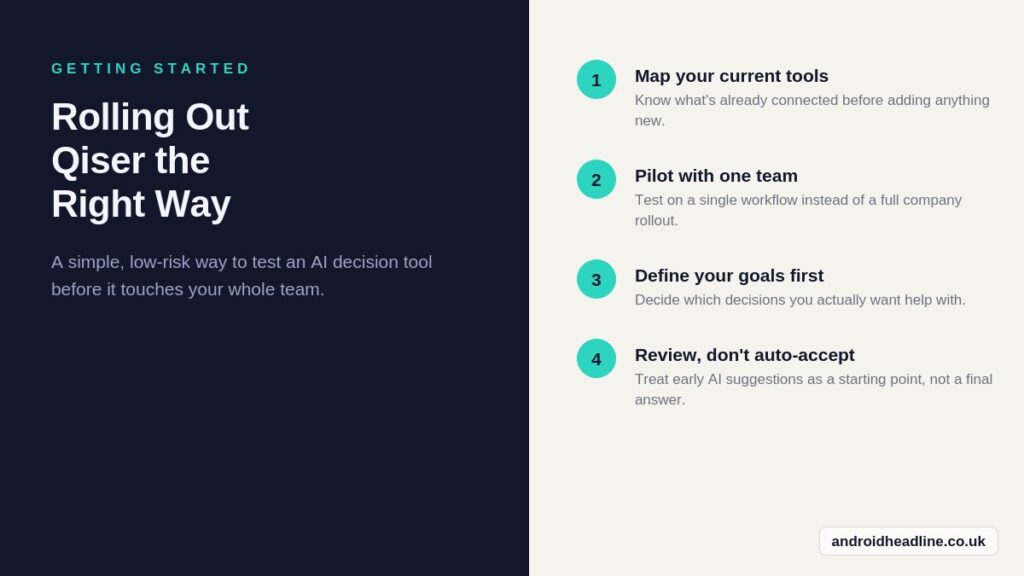
If you’re thinking about trying it out, here’s how I’d approach it:
- List your current tools first. Know what you’re already using before you connect anything new. It’ll help you see where the actual data gaps are.
- Start with one team or one workflow. Don’t roll it out company-wide on day one. Test it somewhere small first.
- Set clear goals before you connect data. Decide what kind of decisions you actually want help with, whether that’s hiring, budget, or product priorities.
- Review the AI’s suggestions critically. Treat early recommendations as a starting point, not gospel, until you’ve seen how accurate they are for your specific business.
- Check in after a month. Most reports on tools like this suggest it takes several weeks before patterns and recommendations really start to feel useful.
For more on how decision intelligence tools fit into a broader tech stack, our guide on connecting your business tools without the chaos walks through a similar setup process.
A Quick Honest Note on What’s Still Unclear
I want to be straight with you here. While researching this piece, I noticed that different sources describe Qiser in slightly different ways. Some frame it as a startup-focused execution tool, others describe it more as a broader enterprise analytics platform, and a few use “qiser” almost like a general decision-making skill rather than a specific product.
That’s not unusual for a tool that launched recently and is still getting media coverage sorted out. But it does mean I’d recommend checking Qiser’s own official site and pricing page directly before you commit to anything, rather than relying only on third-party write-ups (including this one).
My Take
I’ve tested a handful of “AI decision assistant” type tools over the past year, and most of them either drown you in dashboards or oversimplify things to the point of being useless. What stands out to me about Qiser’s approach, at least based on how it’s described, is the emphasis on staying human-led. That’s the detail I’d want to verify first-hand if I were considering it for my own team.
Tool fragmentation is a real problem too. One widely cited industry estimate puts the average number of cloud tools a company uses well over 100, which lines up with what I’ve seen working alongside growing teams. That’s a lot of scattered data, and it’s exactly the kind of mess a connective layer like this is meant to sort through.
Wrapping Up
So, what is Qiser? Based on everything available right now, it’s an AI-powered decision-making platform built to pull scattered business data into one place and help you figure out what to actually do next, without taking the final decision out of your hands.
It’s not a magic fix, and there are still some inconsistencies in how it’s described across different sources. But if tool sprawl and decision fatigue sound familiar, it’s worth keeping on your radar.