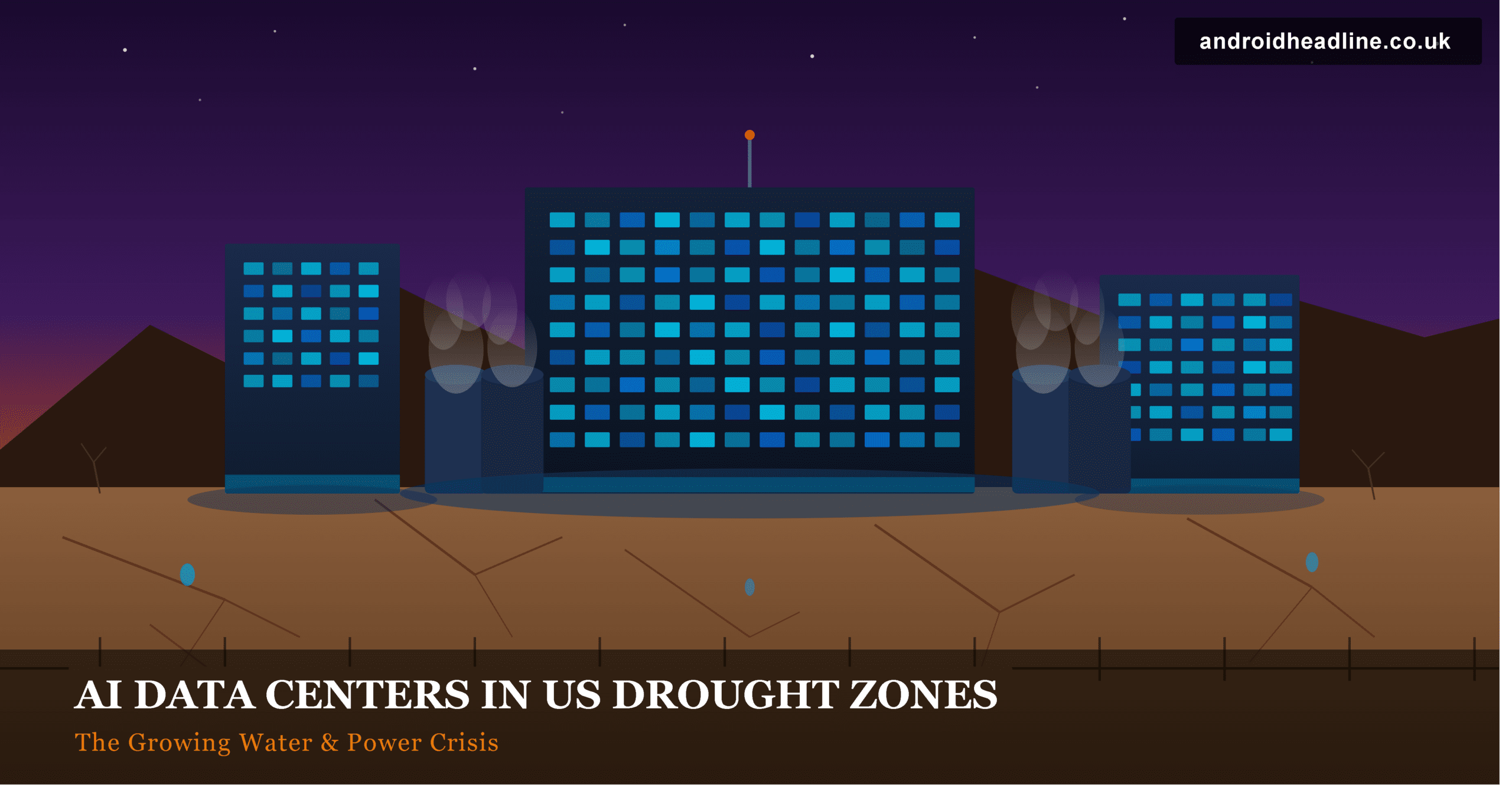
Here’s something that hit me hard recently. I was reading about water shortages in Arizona — how Lake Mead has dropped to historic lows — and then I stumbled across a stat that stopped me cold. Some of the world’s largest AI data centers sit just miles from some of the most water-stressed land in America.
We talk a lot about what AI can do. Cure diseases. Write code. Generate images. But we don’t talk nearly enough about what AI infrastructure costs — specifically the water it gulps down and the electricity it burns through every single day.
In this post, I’m going to walk you through what’s really happening with AI data centers in US drought zones, why it matters more than most people realize, and what — if anything — can actually change. Let’s dig in.
Why Are AI Data Centers Being Built in Drought Zones Anyway?
This is the question I kept asking myself when I first started researching this topic. If water is precious in places like Arizona, Nevada, and New Mexico, why on earth are we planting enormous server farms there?
The honest answer? It comes down to money, land, and cheap power. These states have offered generous tax incentives, wide-open land at low prices, and in some cases cheaper electricity rates. Tech companies went where the deals were — and local governments were eager to bring in those jobs and that economic activity.
What nobody fully planned for was the compounding effect. Now you’ve got dozens of facilities all competing for the same strained water table, in regions where climate change is making droughts worse every decade.
The States Most Affected Right Now
A few places are bearing the brunt more than others:
- Arizona — particularly the Phoenix metro area, which has seen explosive data center growth while simultaneously facing extreme water scarcity
- Nevada — Las Vegas and the surrounding desert host major facilities from some of the biggest names in tech
- Texas — not traditionally thought of as drought country, but prolonged dry spells and a fragile power grid have made things complicated fast
- New Mexico — smaller scale but growing, and already water-poor
The Water Problem — How Much Are We Actually Talking About?
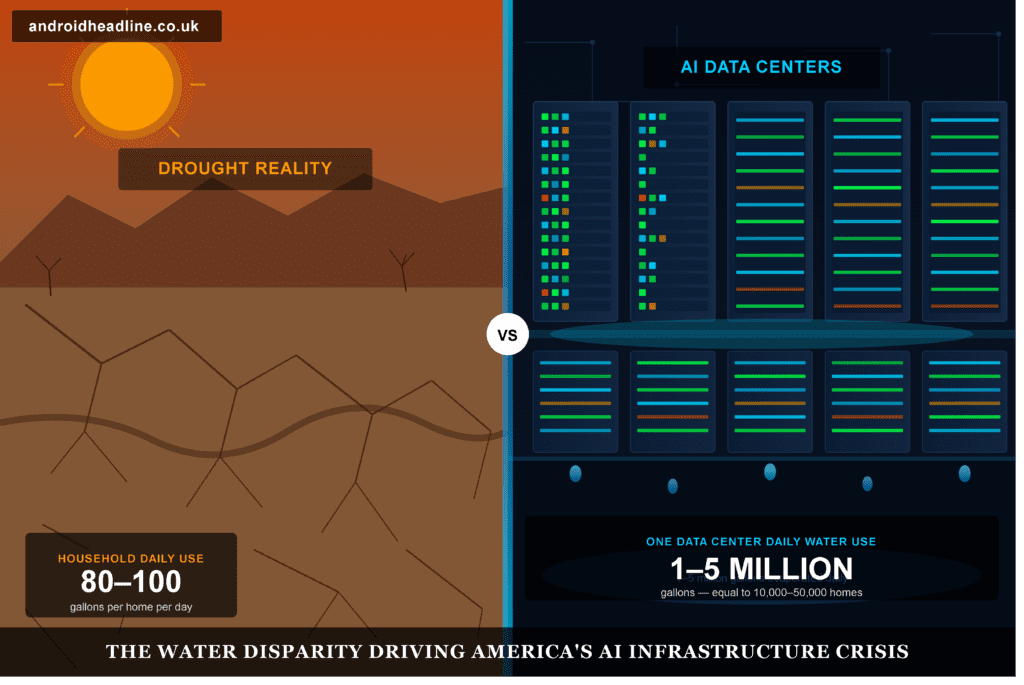
I’ll be honest, I didn’t fully grasp this until I saw specific numbers laid out. A single large data center can use anywhere from 1 million to 5 million gallons of water per day for cooling. That’s not a typo. Per day.
To put that in perspective, the average American household uses about 80–100 gallons of water daily. So one big data center might consume what tens of thousands of families use — every single day.
AI workloads make this worse, not better. Training large AI models is computationally intense, which means the servers run hotter, which means more cooling is needed. According to reporting from the Washington Post and research published by the University of California, Riverside, the water footprint of AI is substantial and growing.
One figure that’s been widely cited: asking ChatGPT around 20–50 questions can consume roughly a 500ml bottle of water worth of cooling resources. Multiply that by millions of users asking questions all day, every day, and you start to see the scale of the problem.
Evaporative Cooling vs. Air Cooling
Here’s a wrinkle a lot of people don’t know about. Many data centers use what’s called evaporative cooling — essentially, they circulate water to pull heat away from servers, and that water evaporates. It’s effective and energy-efficient. But it uses a lot of water, and in a drought zone, that evaporated water is gone for good.
Some newer facilities are switching to air cooling or closed-loop liquid cooling systems that recycle water instead of losing it to evaporation. It’s a step in the right direction, but adoption has been slow because retrofitting is expensive.
The Power Grid Crisis — AI Data Centers and Electricity Demand
Water is only half the story. The electricity situation is just as alarming, maybe more so.
AI data centers are energy hungry. We’re talking about facilities that can draw hundreds of megawatts of power continuously. For context, a single large facility might consume as much electricity as a small city.
The problem with drought zones specifically? Many of them rely on hydroelectric power — which becomes unreliable or unavailable during droughts. Less water in reservoirs means less power generated. At the same time, rising temperatures from climate change mean air conditioners are running harder, pushing overall grid demand higher.
It creates a brutal feedback loop:
- Climate change causes droughts
- Droughts reduce hydroelectric capacity
- AI data centers still need massive amounts of power
- Utilities scramble to meet demand, often falling back on natural gas
- Natural gas emits CO₂, worsening climate change
That’s not a hypothetical future scenario. It’s already happening in parts of the American West.
How This Affects You (Even If You’re Not in a Drought Zone)
I know some readers are thinking: “I live in Ohio, why does this affect me?” Fair question. Here’s why it does:
- Energy costs ripple through the economy, affecting prices for cloud services, streaming, apps
- Water and power strain in western states affects agriculture, which affects food prices nationwide
- Tech infrastructure outages caused by grid instability can knock out services you use daily
- Investment in these regions diverts public resources from other infrastructure needs
This isn’t just a western states problem. It’s an American infrastructure problem wearing a tech costume.
What the Industry Says — and What’s Missing From That Conversation
Big tech companies aren’t ignoring this, to be fair. Microsoft, Google, and Amazon have all made public commitments around water use and carbon emissions. Microsoft has pledged to be “water positive” by 2030, meaning they want to replenish more water than they consume.
That’s genuinely good. I don’t want to dismiss it.
But — and this is where I get a little impatient — commitments and reality have a gap. The demand for AI infrastructure is growing faster than green alternatives can scale. New data centers are still being approved, permitted, and built in water-stressed areas right now. And the timelines for renewable energy transitions often stretch a decade or more.
There’s also a transparency problem. Many companies don’t disclose exactly how much water their facilities use, and there’s no federal requirement to do so. You have to piece it together from sustainability reports, local utility filings, and investigative journalism.
A Few Practical Things That Could Actually Help
Okay, I don’t want this post to just be doom and gloom. There are real levers here — some for policymakers, some for companies, and some surprisingly for regular people.
For companies and data center operators:
- Mandate water disclosure. If companies publish detailed, standardized water consumption reports, investors and communities can hold them accountable. Transparency alone shifts behavior.
- Prioritize closed-loop cooling systems that recycle water rather than evaporating it. Yes, they cost more upfront, but the math changes fast in a water-scarce environment.
- Site new facilities near renewable energy sources and adequate water supplies — not just near cheap land and tax breaks.
- Invest in waste heat recovery. The heat data centers produce could heat buildings, greenhouses, or industrial facilities nearby. Most of it currently just… goes into the air.
For policymakers:
- Require environmental impact assessments that specifically address water use before permits are granted
- Offer enhanced tax incentives for data centers built in water-abundant regions or those using renewable energy from day one
- Fund research into next-gen cooling technology at the federal level
For individuals (yes, this part matters):
- Support transparency: when companies publish sustainability data, engage with it, share it, and demand better
- Ask your local representatives whether your municipality has data center planning guidelines
- When you have a choice between cloud providers, research their environmental commitments
I’ll be real with you — individual action here is more about creating social and political pressure than directly changing outcomes. But that pressure absolutely works.
A Personal Take — Why I Think We Got Here
I’ve been covering tech trends for a while now, and I think what happened here is pretty human and pretty predictable. AI took off faster than almost anyone expected. The demand for computing power went from “a lot” to “staggering” in a matter of months, not years.
Infrastructure planning doesn’t work at that speed. The regulatory frameworks, the environmental reviews, the community conversations — none of that was set up to move at Silicon Valley velocity. And so facilities went up, deals got done, and now communities are waking up to the downstream effects.
I’m not villainizing the tech companies here. I think most of them genuinely want to do better. But “we’ll fix it later” is a risky strategy when what you’re depleting is a non-renewable resource like an underground aquifer.
The good news? This is a fixable problem. It requires will — political, corporate, and public — but the solutions exist. We just have to decide we care enough to use them.
What to Watch in the Coming Years
A few developments worth keeping an eye on:
Federal regulation: There are early-stage conversations in Congress about requiring environmental disclosures from large data center operators. Nothing’s passed yet, but the conversation is happening.
Nuclear power for AI: Several tech companies have signed deals or expressed interest in powering data centers with small modular nuclear reactors. It’s controversial but it’s real — and it could sidestep the renewable intermittency problem.
Water rights battles: In states like Arizona and Nevada, existing water rights are already contested. As data centers compete with agriculture, municipalities, and Native communities for access, expect legal battles.
AI efficiency improvements: Models are getting more efficient. GPT-4 does more per watt than earlier generations. If this trend continues, the energy and water footprint per query could shrink significantly — even as overall demand grows.
Conclusion: The Invisible Cost of AI
So here’s where I land on all this. AI is genuinely remarkable technology. I use it. You probably use it. And the innovation that’s coming is worth being excited about.
But we’re not having an honest public conversation about what it costs to run. The water being used — and in many cases, permanently lost — in drought zones isn’t just an environmental footnote. It’s a real resource that real communities depend on. The strain on power grids affects real households, especially lower-income ones who can’t easily absorb rate hikes.
We can build a smarter AI future. One that’s powered by renewable energy, cooled by recycled water, and sited in locations that can actually support it. But that requires us to ask harder questions and accept that not every data center deal is a good one, no matter how many jobs it promises.
If you found this useful, I’d love for you to share it — especially with anyone who thinks the environmental impact of AI is someone else’s problem to solve. And drop a comment below: what’s your take on how we balance AI’s potential with its footprint? I read every response.
Frequently Asked Questions
Q: Why do AI data centers use so much water?
A: Most large data centers use water-based cooling systems (evaporative cooling) to prevent servers from overheating. AI workloads are particularly intense, generating more heat and requiring more cooling than traditional computing tasks.
Q: Which US states have the most data centers in drought-prone areas?
A: Arizona, Nevada, Texas, and New Mexico have significant data center infrastructure in regions that experience frequent or severe drought conditions.
Q: Can AI data centers switch to greener cooling methods?
A: Yes. Closed-loop liquid cooling systems and air cooling reduce water consumption significantly. Some newer facilities are adopting these technologies, though widespread adoption has been slow due to cost.
Q: Are tech companies required to report their water usage?
A: Currently, there’s no federal requirement in the US for data centers to disclose water consumption. Some companies voluntarily include this in sustainability reports, but the data isn’t standardized or consistently available.