If you’ve been waiting for Apple to finally fix Siri, you’re not alone. I’ve been using an iPhone since the Siri days felt magical (remember when it actually felt new?), and honestly, the last few years have been a bit of a letdown. So when I heard that Apple scrapped an earlier Siri AI version before rebuilding it from scratch, my first thought was: “Wait, they had something working and just… threw it out?”
Turns out, yes. That’s exactly what happened. And the story behind it tells us a lot about how Apple thinks, where it went wrong, and why the new Siri AI might actually be worth the wait. Let’s break it down.
What Happened to the First Siri AI Version?
Here’s the short version. Apple had a working Siri upgrade ready last year. It wasn’t some half-baked prototype either — it was functional and it shipped tool-calling features on top of the classic Siri framework.
But Apple’s leadership looked at it and said, basically, “this isn’t it.”
The Original Plan Was an Incremental Upgrade
The first attempt at Siri AI was built as an add-on. Engineers bolted new AI capabilities onto the existing Siri codebase instead of starting fresh. That’s a pretty normal way to build software, by the way — you don’t always need to reinvent the wheel.
According to Mike Rockwell, who took over Apple’s Siri platform team in 2025, the team had “added tool calling” to the old Siri and “had it working,” as he explained during a WWDC press roundtable covered by 9to5Mac. So this wasn’t vaporware. It was real, functioning software.
Why It Wasn’t Good Enough
So why scrap something that worked? Because “working” and “great” are two very different things.
Rockwell admitted the incremental version didn’t deliver on Apple’s bigger vision for what Siri AI should feel like. The team had also sketched out a more ambitious design that needed much deeper changes than a simple patch job could offer.
Apple chose the harder path. Instead of shipping something decent, they tore the whole thing down and started over — literally, in Rockwell’s own words, from the ground up.
I get why that’s a tough call internally. Nobody likes telling their boss “we built this, but we’re not using it.” Yet that’s the kind of decision that separates products people love from products people just tolerate.
Inside Apple’s Decision to Rebuild Siri AI From the Ground Up
This wasn’t a quiet, behind-the-scenes pivot either. Apple talked about it openly at WWDC 2026, which tells you they’re confident the gamble paid off.
What Rockwell and the Team Actually Said
During the roundtable, Rockwell described going back and rebuilding Siri completely on top of Apple’s newer foundation models. He framed it as the only way to get a “profoundly more capable” assistant, rather than a slightly smarter version of the old one.
Craig Federighi, Apple’s software chief, backed this up in earlier interviews too. He’s said before that there’s no reason to rush out the wrong product just to claim a “first” — a pretty fair point, especially after how messy Apple’s 2024 AI promises turned out to be (more on that below).
The New Foundation Underneath Siri AI
The rebuilt Siri AI runs on Apple’s next-generation Foundation Models, which include on-device processing and server-side processing through Apple’s Private Cloud Compute system. Apple has also confirmed it worked with Google on parts of the underlying model technology, while insisting none of Google’s consumer apps or search are involved in how Siri AI actually responds to you.
That’s a notable shift. Apple has spent years insisting it builds everything itself. This time, it leaned on outside help to get the quality bar where it needed to be.
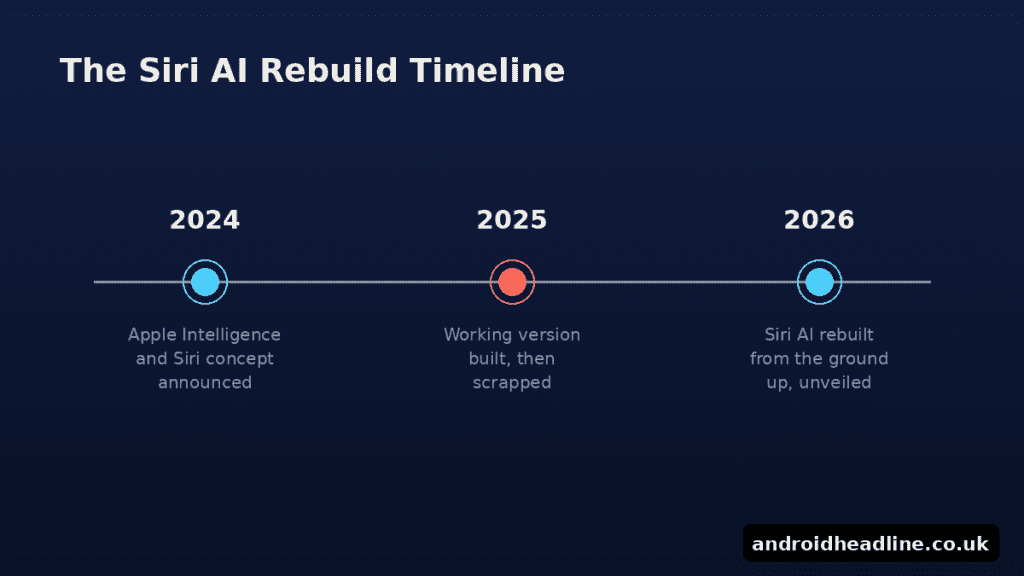
A Quick Timeline, Because It Helps to See It Laid Out
It’s easy to lose track of how long this whole saga has actually taken. Here’s the rough timeline as I understand it:
- WWDC 2024: Apple announces Apple Intelligence and shows off a Siri concept video, promising deep personal context and app actions.
- Through 2025: The promised features slip. Apple builds an incremental version with tool-calling, gets it working, but isn’t happy with it.
- Late 2025: Apple settles a $250 million class action lawsuit tied to the original Siri AI marketing claims.
- WWDC 2026: Apple unveils the fully rebuilt Siri AI, two years after the original announcement.
Two years is a long time in tech years. But when I think about how many AI assistants still feel clunky or forgetful, maybe two extra years isn’t the worst trade-off.
What Makes the New Siri AI Different
So what do you actually get with this rebuilt version? Based on what Apple has shown so far, here’s what stands out:
- A dedicated Siri AI app instead of just a voice overlay
- Multi-turn conversations that remember context, not one-off commands
- Personal context awareness, pulling from your messages, emails, and photos
- On-screen understanding, so it knows what you’re looking at
- More natural, expressive voice options you can adjust for pace and tone
This is a real jump from the old “set a timer” Siri most of us grew used to ignoring.
Why This Matters for Apple Users (and for Apple Itself)
Here’s my honest take: this story matters beyond just specs and features.
Apple promised an AI-powered Siri back in 2024, and it didn’t deliver on time. That delay wasn’t free, either — Apple agreed to a $250 million class action settlement after iPhone buyers said they were misled about Siri’s AI capabilities. That’s a real cost for moving too fast on marketing and too slow on actual shipping.
Lessons For Other Tech Companies
I think there’s a bigger lesson hiding in this story for anyone building AI products, not just Apple fans.
It’s tempting to ship the “good enough” version just to keep up with competitors. But if Apple’s experience shows anything, it’s that a rushed AI product can cost you more in trust (and lawsuits) than waiting an extra year ever would.
I’ve tested plenty of half-finished AI features from various apps over the past couple years, and most of them get quietly removed or rebuilt anyway. Apple just did that rebuild before shipping instead of after — which, credit where it’s due, is the harder but smarter move.
How to Try Siri AI When It Launches
If you want to be ready to test the new Siri AI as soon as it rolls out, here’s a simple checklist:
- Check your device compatibility. Apple has said the most capable on-device experience needs an iPhone 15 Pro or later, M1 Mac or later, or other recently supported devices.
- Update to the latest iOS or macOS beta once Apple opens public beta access later this year.
- Turn on Apple Intelligence in your device settings if it isn’t already enabled.
- Set your language to English for now, since Siri AI is launching there first before expanding.
- Keep an eye on regional availability, since the EU and China won’t get it right away due to regulatory issues.
Small steps, but they’ll save you the “why isn’t this working” headache later.
Quick FAQ
Did Apple really throw away a finished Siri AI version? Yes. Apple confirmed it had a working, incremental Siri AI upgrade ready last year but chose not to release it because it didn’t match their long-term vision.
Is the new Siri AI built entirely by Apple? Mostly, but not completely. Apple has confirmed it partnered with Google on parts of the underlying model technology, while keeping the actual assistant experience built in-house.
When can I actually use Siri AI? Apple plans a public beta later this year, starting in English in the US and select other regions.
Wrapping It Up
Apple scrapped an earlier Siri AI version before rebuilding it from scratch, and honestly, that decision says a lot about where the company’s head is at. They didn’t want to ship something just okay. They wanted Siri to actually compete with what ChatGPT, Gemini, and other assistants can already do.
Will it live up to the hype this time? We’ll find out when the public beta lands. But for once, I’m cautiously optimistic — and that’s not something I say about Siri very often.
What do you think — does this rebuild make you more excited to try Siri AI, or are you still skeptical after the last couple of years? Drop a comment below, and if you found this useful, share it with a fellow Apple user who’s been waiting on this update too.