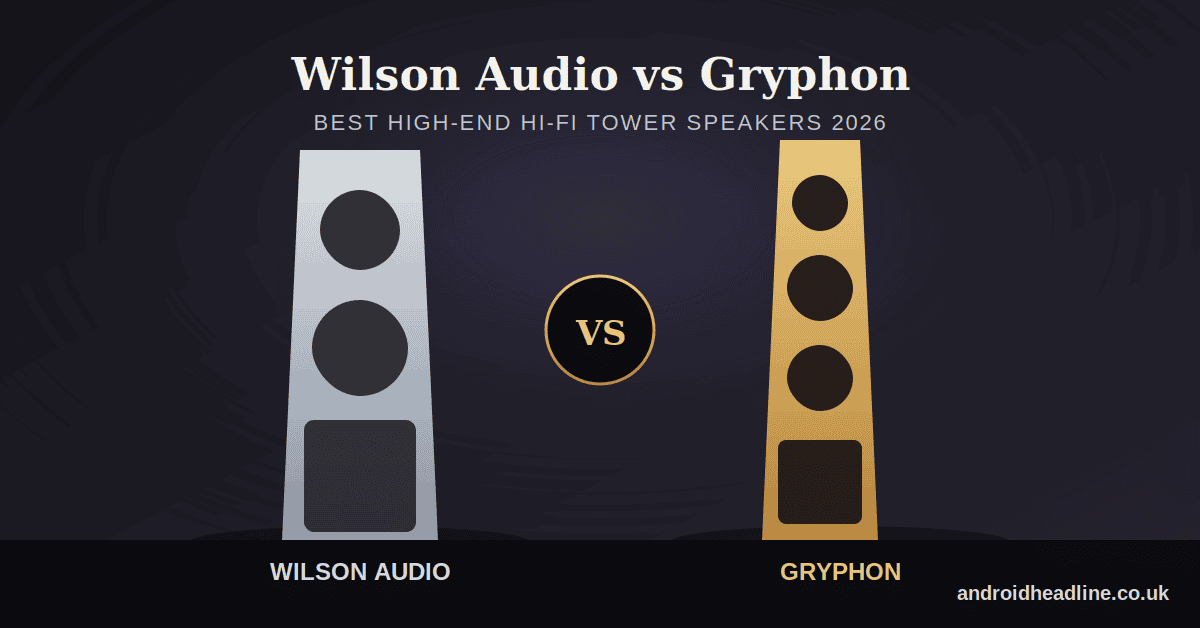
So you’re chasing the best high-end hi-fi tower speakers 2026 has to offer, and you’ve landed on two names that keep popping up: Wilson Audio and Gryphon. I get it. Both brands have that “I just sold my car to buy speakers” reputation, and honestly, that reputation is earned.
I’ve spent the last few months reading reviews, talking to dealers, and geeking out over spec sheets for both brands. In this post, I’ll break down how Wilson Audio and Gryphon actually compare, so you don’t have to spend your weekend doing what I just did. By the end, you’ll know which brand fits your room, your budget, and your ears.
Why Tower Speakers Still Rule High-End Hi-Fi in 2026
Floorstanding speakers just have a presence that bookshelf setups can’t match. They move more air, they go lower, and honestly, they look incredible in a living room.
With streaming quality getting better every year, more people are finally investing in real speakers instead of a soundbar. That’s pushed brands like Wilson and Gryphon to keep innovating instead of resting on old designs.
Wilson Audio, for example, just introduced a new flagship model called the Autobiography, a reference-class tower that pushes their cabinet materials and driver tech further than ever before. It’s a good sign the high-end market isn’t slowing down anytime soon.
Meet the Contenders
Wilson Audio: American Precision Engineering
Wilson Audio has been building speakers in Provo, Utah since 1974. The brand is known for rock-solid cabinets made from proprietary composite materials instead of plain wood, plus a “time-aligned” driver layout that lines up sound from each driver so it reaches your ears at the same moment.
Their current tower lineup runs from the Sabrina V, which is their smallest and most affordable floorstander, all the way up through the Alexia V, Alexx V, and the massive Chronosonic XVX. The Sabrina V starts around $28,500 a pair, which honestly counts as “entry level” in this world.
Gryphon Audio Designs: Danish Minimalist Power
Gryphon comes out of Denmark, and their whole vibe is different. Think sleek black cabinets, understated style, and a serious obsession with phase accuracy.
Their Pantheon tower is a great example. It’s the slimmest floorstander in Gryphon’s lineup, but don’t let that fool you. It packs dual 8-inch bass drivers, dual midrange units, and an Air Motion Transformer tweeter that’s known for lightning-fast, super detailed highs. Gryphon calls this their “Constant Phase” approach, and it’s designed to keep every driver working in perfect time with the others.
Sound Signature Showdown
Here’s where things get personal, because sound preference really is personal.
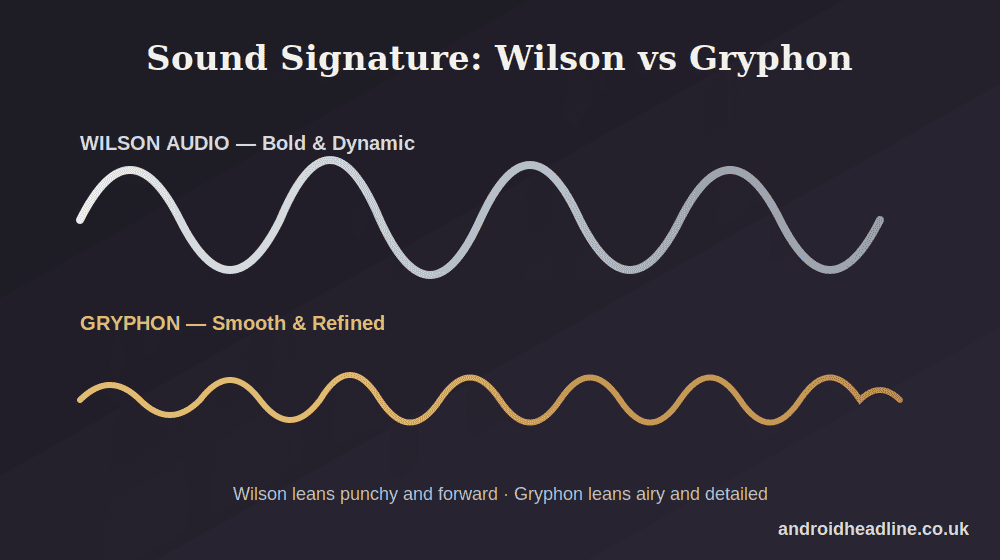
Wilson speakers tend to sound big, dynamic, and a little more forward. They’re great for rock, orchestral music, and anything with punch. I’d describe the presentation as confident, almost like the music is leaning toward you.
Gryphon speakers lean smoother and more refined. That AMT tweeter gives you crisp, airy highs without ever sounding harsh. If you listen to a lot of jazz, vocals, or acoustic music, this might be the better match for your taste.
Quick comparison:
- Wilson Audio: Bold, dynamic, punchy bass, great for larger rooms
- Gryphon: Smooth, detailed, refined treble, great for nearfield or midsize rooms
- Both: Hand-built, obsessive attention to phase and timing accuracy
Build Quality and Craftsmanship
Both brands are basically furniture-grade in terms of finish quality, but they get there differently.
Wilson uses non-wood composite materials, like phenolic resin, then finishes cabinets with an automotive-style paint process. The result is a cabinet that resists resonance and vibration, which matters a lot for clarity.
Gryphon leans on massive internal bracing, modular baffles for each driver, and hand-adjusted crossovers with premium parts. Their crossovers are even battery-biased to reduce distortion, a small detail that shows how far they go for accuracy (Source: Gryphon Audio Designs).
Price and Value for Money
Neither brand is cheap, but there’s still a real gap between them at the entry point.
- Wilson Sabrina V: around $28,500/pair — Wilson’s most accessible floorstander
- Gryphon Pantheon: around $45,000/pair (roughly €35,000 at launch pricing) — Gryphon’s slimmest tower
- Wilson flagship models: can run well past $100,000/pair depending on size and finish
- Gryphon flagship models: priced similarly high once you move up their range
If budget is tight-ish for this category, Wilson gives you a lower entry point into the brand. If money isn’t the deciding factor, both brands compete at the very top of the market.
Which One Should You Buy? A Simple Decision Guide
Don’t just pick based on brand name. Here’s how I’d actually approach it:
- Measure your room first. Bigger rooms handle Wilson’s scale better. Smaller or midsize rooms often suit Gryphon’s slimmer cabinets.
- Think about your music library. Rock and orchestral fans often lean Wilson. Jazz, vocal, and acoustic fans often lean Gryphon.
- Audition both in person. Specs and reviews only tell you so much. Your ears make the final call.
- Match your amplifier. Both speaker lines are picky about partnering gear, so budget for electronics that can really drive them. Check out our guide on choosing the right amplifier for high-end tower speakers before you commit.
- Plan your placement. Even the best speaker sounds average in the wrong spot. Our tower speaker setup and placement guide walks through toe-in angles and room treatment basics.
My Honest Take
I’ll be upfront: I’m a bass guy, so I gravitate toward Wilson’s punch and scale. But the first time I heard a Gryphon Pantheon on a well-recorded jazz trio track, I actually stopped mid-sentence. That AMT tweeter is something else.
Neither speaker is “better” in some objective sense. It really comes down to what kind of music makes you close your eyes and forget you’re testing gear.
Wrapping It Up
Both Wilson Audio and Gryphon build genuinely world-class tower speakers, just with different personalities. Wilson brings bold American engineering and room-filling scale. Gryphon brings Danish precision and silky top-end detail.
If you’re still deciding between high-end brands in general, our post on budget vs high-end speakers and whether the upgrade is worth it is a good next read.